Falkenbach - Official Website


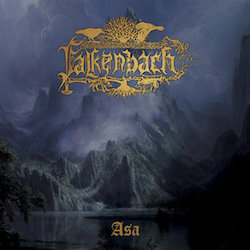
Asa

Germany Country of Origin: Germany

1. Vaer Stjernar Vaerdan
2. Wulfarweijd
3. Mijn Laezt Wourd
4. Bronzen Embrace
6. I Nattens Stilta
7. Bluot Fuër Bluot
8. Stikke Wound
9. Ufirstanan Folk


Review by Fernando on January 14, 2022.

France is a fascinating country when it comes to art and music, and in regard to metal music it's also all over the place, especially in black metal be it the occult and depressing sonic legacy of the Black Legions, the unsavory and controversial fringe side, and even the dissonant Avant-Garde side popularized by Deathspell Omega and Antaeus. Which brings me to Pensées Nocturnes, a Parisian act that’s even more fascinating than the previously mentioned acts. This band has been an oddball since their debut record, but with each album they seem to get weirder and weirder, both in music and presentation, and this continues to be the case with their newest opus Douce Fange, released by Les Acteurs de l'Ombre Productions.

Pensées Nocturnes, is as mentioned, an oddball musical project. The band is classified as neoclassical Avant-Garde black metal, and they certainly get very experimental and outlandish with their music, but this doesn’t show through a dissonant and complex songs, rather, this is a melting pot of all forms of classic French music, filtered through black metal and with a flair for the flamboyant. In many areas the band is playing carnival and cabaret music with some jazzy and bluesy tinges here and there, which include, baritone opera like singing, gang choirs that would feel at home at some pub, the inclusion of accordions, organs, trumpets, cellos, a saxophone, and any other instrument you can think of when you hear words like carnival music and a cabaret. While the music is very eccentric and varied throughout, one element that’s noticeable is how melancholic and even somber the actual atmosphere is despite how colorful the instrumentation is, and this is also displayed through the vocals. PN mastermind Léon Harcore’s vocal range impressively switches between harsh growls, dry and unhinged shouted vocals and deep baritone opera singing. The overall execution and the meshing of such extravagant instrumentation with what often borders on depressive black metal give the entire album an unhinged quality, which is present in every single song, and more impressively, none of the songs play the same, each is a unique experience while being uniform in the instrumentation. If you’re into straightforward black metal then this record will sound like a mess, because at no point do the songs do not include folkloric passages, samples of TV programming, accordions or organs. The overall experience gives the vibe of the urban nightlife of Paris, in all its deranged and flamboyant splendor. And at under 50 minutes, the album is a robust sit through that doesn’t overstay its welcome, nor does it rush to get to the good parts. At first glance this record does sound like pure madness, for better or worse, but what’s impressive here and what can’t be denied is the technical talent of the band, which given how massive this album is, they needed to be talented musicians, and that’s certainly the case, the guitars, bass, drums, keyboards and assorted French instruments are played with such precision and prowess that it serves as the perfect foil to the musical chaos, and if I’m allowed to blabber about philosophy, feels like what good ol’ Fred Nietczhe described as the Apollonian and Dionysian artists, those being the logical, ordered and disciplined, and the instinctual, chaotic and emotional respectively, and that’s this record in a nutshell, it's a wild yet incredibly complex experience, a perfect manifestation of chaos through order. It also makes it hard to single out individual performances because this music and technical prowess could only be achieved by the collective of artists Léon Harcore amassed playing as a unit, and if I signal Harcore is because he’s essentially the ringmaster of this demented circus.

Overall, Pensées Nocturnes continue to deliver a frenzied and somewhat melancholic experience that’s unlike anything else, mainly because of how unapologetically French the music and presentation is. The only major flaw here is really how wild it all is, black metal purists will probably hate how over-the-top this record and band is, fans of experimental music will take issue with the black metal parts of the record, and normies will most definitely be intimidated by the circus organs and accordions playing next double bass drums, tremolo picking and a madman bellowing and growling. But to those bold and twisted enough, willing to take the plunge, this one’s worth recommending.

Best tracks: 'Quel Sale Bourreau', 'Saignant Et à Poing', 'Le Tango Du Vieuloniste', 'Gnole', 'Torgnoles Et Roubignole'

Rating: 8.5 out of 10

   1.49k

Review by Felix on May 1, 2019.

Three letters stand for the rebirth of the "true" Falkenbach. Asa. After some pretty mellow outputs, I thought that Markus Tümmers would not be able anymore to return to a harsher approach, but he surprised me in a very pleasant way. This does not mean that this album with its perfect artwork, another great picture of Albert Bierstadt, does not house silent tones. Nonetheless, they do not prevail, even though one of the absolute highlights of this work belongs to the most meditative tracks the dude from Düsseldorf has ever written. The more or less spiritual "Eweroun" is like a long and silent river, but its immaculate melody makes it to something great and the calming yet powerful vocals deliver the cherry on the top. All these cautious tracks from the last three albums suddenly make sense if we understand them as a necessary exercise in order to create finally this mantra-like masterpiece which is the perfect invitation to sit down and relax. Just listen, enjoy the flawless production of Asa and let your thoughts flow freely. 

A handful of tracks reflect the predatory side of Falkenbach. "Wulfarweijd", "Bronzen Embrace" or "I Nattens Stilta" make clear that Tümmers has rediscovered his will to shatter the silence every now and then. Not to mention the furious "Stikke Wound" which presses the artist's rage in a hefty eruption of less than three minutes. These songs illustrate that there is still a fiery core in Falkenbach, while I had been in fear that he just stores the ashes instead of keeping the fire burning. Needless to say, that there are also some very typical songs which combine excessive melody lines with clear, announcing vocals. These tunes show up like the mighty mountains on the artwork which appear out of the mist. No doubt, the lone wolf combines his tried and tested trademarks with stormy outbursts and the result is absolutely convincing. A mostly solemn yet occasionally nearly cruel atmosphere dominates the sound and it feels good that the modern skald is willing to offer his complete portfolio again after some years of voluntary self-limitation. He never released a really weak album, but it is simply great to hear his cocktail of robust guitar chords, almost mystical keyboard lines and raw vocals. The mix is what matters and unlike its predecessors, Asa finds the right balance. 

Maybe (or certainly?) I am a picky old geezer, but I will never understand the way of thinking of some people. Why wasn't it possible to press the thirteen tracks of the 2CD-version on one disc? Who felt the need to seduce the fans to buy a luxury version? Of course, we all know the stale "excuse" of the industry: nobody is forced to buy an album, we just make an offer. But come on, that's ridiculous in view of the well-known mindset of a loyal metalhead. Be that as it may, the four tracks of the second disc achieve the same quality level as the regular tracks and they also do not follow another stylish approach. Okay, don't be fooled by the title of "Return to Ultima Thule". It is not part two of "Ultima Thule" from the debut, but a strong alternative version of this track. The recycled composition shows once again the glory of the early days of the band due to its strict and compelling pattern. Yet the remaining material of the second disc is completely new and with that said, it goes without saying that the second disc enriches the entire output sustainably. This even applies to the calm closer, an instrumental which reminds me of the rather peaceful songs of In Extremo (but without bolshy bagpipes). In a nutshell, this edition of Asa delivers the soundtrack for the next midsummer festival in Thule. Enjoy the very strong hour of pagan / black metal while avoiding any kind of fillers. Hopefully, Tümmers returns soon with an equally strong successor.

Rating: 8.5 out of 10

   1.49k