Deathhammer - Official Website


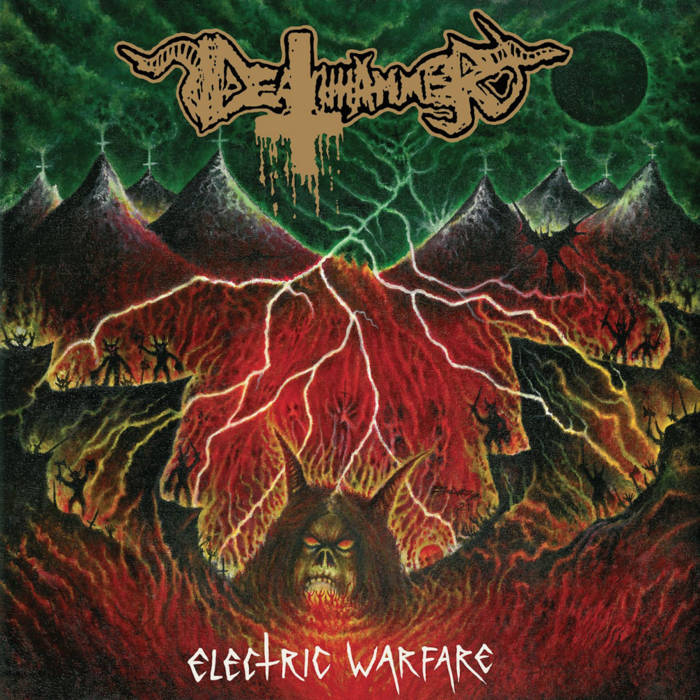
Electric Warfare

Norway Country of Origin: Norway

1. Savage Aggressor
2. Crushing The Pearly Gates
3. Enter The Morbid
4. Return To Sodom/Soldiers Of Darkness
5. Rapid Violence
6. Thirst For Ritual
7. Thrown To The Abyss
8. Violent Age Of Bloodshed


Review by Mandeep Arora on April 21, 2024.

For all its similarities, King Diamond the band is a stylistic departure from the classic Mercyful Fate sound - the songs get shorter, less progressive and more defined (verses and choruses, the like) and the lyrical themes change from the occult to full-fledged ghost stories. Or possessed chains. Or puppet masters... Admittedly, King Diamond is a more grandiose, more theatrical sound to Mercyful Fate's outright diabolical facet but still retains the latter's classic bits: King's signature falsettos (now used more often and in various ranges), great songwriting, and immaculate guitar leads. Fatal Portrait, being their first album, acts like a bridge between the classic Mercyful Fate era that preceded it and the classic King Diamond era that succeeded it, in the sense that it's a slight mix of both the styles and seems experimental in its execution - Halloween with its main riff chugging along the length of the song is very Mercyful Fate-like but the other songs fall in line with what is essentially the later King Diamond sound.

It's not a completely conceptual album - only four of the eight songs are dedicated to this young dead girl's story, which is pretty chilling and one of King Diamond’s more underrated ones. Also because he is playing a range of characters as that of the narrator and the girl child this time, and even other entities on the non-conceptual songs, he experiments a lot with his vocals, singing in a certain voice one moment, then switching to a completely different one the other. It seems to work for the better part but also comes across as slightly awkward and out of place at times. You can attribute this to the vocal shifts being sudden and, sometimes, abrupt, meaning that you'll be least prepared when it happens, thus blighting your initial listening experience. This is especially highlighted on the shorter non-conceptual songs like Dressed in White and Charon, or even Haunted, which is related to and concludes the main story. If you want to get accustomed to King's vocal style, then Abigail and The Eye best serve that purpose; Fatal Portrait does not seem like the ideal starting point to get into the band.

The album starts off strong - the first three songs lend it more than half its credibility and elevate to make it a good listening experience already. The organs, keyboards and synthesisers take center stage, initially at least, to realise the story's demands and there's stronger emphasis on atmosphere to accentuate that feeling of eerie and spookiness. They do accomplish that effect, but whether it sounds legitimately scary or stupidly cheesy depends on your train of thought; I think I occupy the middle ground here. The production may be a bit muffled but it amplifies the atmospheric traits and has an odd charm to it. King's vocal harmonies play a huge role too, and he actually sounds majestic and mesmerising on choruses, where his falsettos lend a certain melody to the sound that's unique only to him and his style. I think The Jonah captures that essence beautifully and is also my personal favourite song here - its progressive composition builds up nicely, and the riveting outro with its never-ending stream of slower, atmospheric riffs has an almost hypnotising effect on you.

In comparison, other songs seem pretty straightforward, with prominence on King Diamond's signature trait: guitar melodies. Abundance of them. The leads go from being graceful and elegant on the longer songs to frenetic yet soulful on the shorter ones. There's no dearth of badass riffs that are plenty fast and traverse between power and speed metal styles and sometimes in line with traditional heavy metal. Mickey Dee's ever-present behind the drums to breathe immeasurable gusto into the sound and while his moment under the sun as a monstrous force of nature wouldn't come until Abigail, the sheer power he lends to the music here is what made King Diamond an absolute unit of a band in its early years. On the other hand, Timi Hansen with his basslines maintains a restrained approach of less is more for the better part of the album but hearing him rip it apart in concurrence with the final guitar melodies on The Portrait is one of metal's many delights and probably my favourite moment on the album. Skeptical Mercyful Fate fans rejoice, you have not been let down!

But let down you may be once the story takes a pause and the shorter songs come into play, as the album then begins to lose some steam. Mind you, these are pretty fun songs in isolation but their awkward placement makes them seem somewhat directionless and abrupt, now not seeming a collective unit as an album but rather as individual songs with varying directions. It's a minor, and maybe a very personal, niggle and most people may not notice or care altogether. And it does not seem to shroud the good bits, of which there are plenty. Mercyful Fate may have been the beginning of the legend but King Diamond is what made them boys a household name - one couldn't argue the appeal and novelty of evocative and saturated album covers, chilling and well-written story concepts, creepy and iconic characters, and whimsical, over-the-top concerts. Fatal Portrait is the embodiment of all that - a fantastic debut in nearly every way that laid the foundation for the band's future, and even better, classics.

Rating: 8.5 out of 10

   861

Review by Faithless on January 8, 2021.

To start, I don't think King Diamond needs an introduction; many of the reviews previously posted have done so. I will go directly to business; however, I have to address something first: Fatal Portrait is NOT Mercyful Fate's third album as some fanboys like to say. We need to understand that although the frontman of both bands is the same, the personification tends to be also alike and even the voice resembles both acts; Fatal Portrait doesn't intend to be a sequel of Mercyful Fate's previous work. I strongly believe the album stands alone as the beginning of what in my opinion is the groundwork for the most important heavy metal concept albums of the 80s, such as Abigail, Them, and Conspiracy.

King Diamond's over the top vocals are undoubtedly recognizable and that was the driving force as well as the natural transition of Fate's fans to embrace the new project. As I said before, both bands share certain similarities but I think the sound developed in Fatal Portrait demonstrated a more melodic music approach, variety of vocal textures and songwriting, and the first attempt of horror narrative. For instance, 'Haunted' and 'Lurking in the Dark' display plenty of melodies both in King's vocal acrobatics and La Rocque/Denner guitars duo. On the other hand, there are also more straightforward rocker songs like 'Charon' and 'Halloween'. King did not want to live in the shadow of Mercyful Fate and that's something you can tell in the Fatal Portrait song-writing variety. In the version I’m reviewing we can find two bonus tracks; 'No Presents for Christmas' and 'The Lake'. These songs were not included in the original release but I think complement the album well. For example, 'No Presents for Christmas' was issued as a holiday single and shows a humorous side in King´s songwriting skills (something that was not very likely to happen on a Mercyful Fate record). Fatal Portrait takes you on a trip over the seas of energetic music as well as bombastic and melodic tunes that are memorable; full of hooks and sudden changes in the rhythmic section lead by Mikkey Dee and Tim Hansen. The overall sound is loyal to the heavy metal ideals of the 80s without being too cheesy or stereotypical (no hair metal here only straight forward metallic tunes)

Let's get into a brief song by song description of the album. 'The Candle' casts you on a spell with a short intro full of a church like keyboards and the demonic voice introducing us into the horror tale. Then, you hear King's falsetto mixed with the guitar melody and there is no escape; you are trapped into the musical madness. In my opinion, King's vocals are an acquired taste, you love them or hate them but there is no middle point. In my case, I think the vocals fit perfectly with the music's approach and mood, he is a narrator and the different textures included in this recording (highs, over the top highs, lows, evil laughter, etc.) help to get you hooked into the horror tale dynamics. Next, 'The Jonah' also starts with a short intro with some spoken words, similar to the first track but taking a more mid-tempo focus at the beginning to end up changing gear into faster passages. 'The Portrait' is perhaps one of the most melodic driven songs on Fatal Portrait delivering godly guitar riffs and solos that position Andy and Michael as flawless eighties shredders. Then, we have 'Dressed In White' to close side A of the album. This song keeps up with the general melodic/bombastic vibe of the record and demonstrates the unique vocal style that King Diamond possesses. Unfortunately, if I have to say something negative about Fatal Portrait it would be the lack of cohesion between the horror tale and the stand-alone songs. The concept album was still not clear due to the inclusion of stand-alone songs like 'Charon', 'Lurking in the Dark' and 'Halloween'. These songs are great but kind of break up the flow of the horror tale being narrated by the King himself. The fact that there is a gap between 'Dressed In White' and 'Haunted' is a bummer and cuts the narrative in some way. However, the story is mesmerizing and sat the basis for what was coming on Abigail. The five-song cycle, beginning in 'The Candle' and finishing with 'Haunted' tells the story of a haunted portrait (and a haunted candle) and the music dynamics match perfectly with the moods of the story. The album itself is heavily influenced by horror movies and the shock rock work of Alice Cooper. Another argument that detaches Fatal Portrait from the more satanic oriented lyrics in "Melissa" and "Don´t Break the Oath".

All things considered, there is no doubt that this record is one of the foundations for future concept albums not only released by King Diamond but also influential for hundreds of metal bands yet to come. Despite the concept album is not achieved due to the lack of coherence in some parts of the album or maybe the tracklist was not properly organized. Fatal Portrait contains more pros than cons and has aged with dignity through the years, showcasing a top line-up with some war veterans recruited from Mercyful Fate's machinery (Tim Hansen and Michael Denner). Let’s not forget the hell of a show that this band put together when they hit the stage, King's theatricals fit like a glove into the whole horror concept approach distancing themselves from the more straightforward satanic/occult Mercyful Fate style. In the end, Fatal Portrait stands as the first candle in the candelabrum of great albums that the band released during the 80s and part of the 90s.

Rating: 9.5 out of 10

   861

Review by Felix on April 20, 2022.

Deathhammer. Do I need to say more? We know this band that has taken a big gulp from the blood-filled chalice of Norwegian black thrash. On Electric Warfare, they surprise with some long compositions that exceed the seven-minutes-mark. That’s a bit difficult for me. I have made myself comfortable in the prejudice that real black thrash must be dirty, straight and to-the-point. But already the first “monumental” track, 'Crushing The Pearly Gates' (6:23) shows that Deathhammer are able to deliver long songs that are neither complex nor repetitive. They just have a good flow. On the other hand, a track like 'Enter The Morbid' (3:01) illustrates that these short, nasty and accurate rockets still work. But it’s not a matter of length – 'Rapid Violence' lives up to its name and hits the listener continuously for five minutes. A short mid-tempo part has only been integrated to improve the dynamic.

Every now and then I get the thought that Deathhammer are acting a little less boldly than in their early days. Some almost melodic solos (or should I say fragments of solos) show up and a small number of guitar lines would also be suitable on a speed metal output. Deathhammer surprise with some airy and nearly light tones, but don’t worry, most parts of the album could still come directly from Lucifer's pen. (But they don't, this guy is supposed to be completely unmusical.) Either way, 'Thrown To The Abyss' should be a song he likes, because its beginning delivers one of the rather rare moments of infernal atmosphere. Usually, the blitzkrieg-like played guitars do not take care a lot for sinister vibes, but for speed and restlessness. The vocals also do not focus on demonic sounds. A pretty high number of high-pitched screams adds an eighties-feeling and so Deathhammer construct a fine bridge between the golden decade of metal and our modern times with its f**king war in the Ukraine. By the way, today Russia confirmed the loss of its flagship in the Black Sea – maybe this was a very successful act of Electric Warfare?

But let’s come back to the album of the same name. Deathhammer haven’t lost their power and their integrity. (This means among other things that the artwork sucks again...) Their crisply and freshly produced release is probably not strong enough to be considered as a new classic and the highlight in their discography. Anyway, Sargeant Salsten and Sadomancer are a well-coordinated team. They haven’t released a disappointing work so far and Electric Warfare continues this interesting line. The duo does not run out of ideas, its music still delivers the necessary amount of dirt and throwaway tracks are fortunately missing. In short, it is always fun to receive lively and underground-compatible albums like Electric Warfare.

Rating: 7.8 out of 10

   861