
Belphegor - Official Website
Pestapokalypse VI |
Austria
 |
|---|

Type: Full-Length
Release Date: October 27th, 2006
Label: Nuclear Blast
Genre: Black, Death
2.
Seyn Todt In Schwartz
3.
Angel Of Retribution
4.
Chants For The Devil 1533
5.
Pest Teufel Apokalypse
6.
The Ancient Enemy
7.
Bluhtsturm Erotika
8.
Sanctus Perversum
9.
Das Pesthaus / Miasma Epilog
Review by HanSathanas on August 5, 2026.
I had an on-and-off affair with Austria’s long-running slaughterhouse Belphegor. First acquainted with this group back in the late ’90s through Nuclear Blast’s "Death Is Just the Beginning" compilation, it wasn’t until the mid-2000s that I would rediscover my one-off encounter with Belphegor and decide to pursue the band’s discography. The song that started it all for me was 'In Remembrance of Hate and Sorrow.' Fast forward a couple of years, and "Pestapokalypse VI" was unveiled before the world. The band was tighter, faster, and all the more brutal than their ’90s incarnation; qualities that helped provide a high-definition resolution of their musicianship for those seeking to flood their system with relentless dopamine shots.
Known for its unrepentantly transgressive, boundary-breaking approach to artistic expression, Belphegor continued its savage bludgeoning from the very first track, 'Belphegor – Hell’s Ambassador.' No intro this time, just the band going straight for your throat, stabbing it multiple times even when you are already dead and your head has been severed completely. The riffs are a destructively cyclonic force of nature, so unhinged that they are passionately calming at the same time. It’s like you are standing in the eye of a storm, witnessing the utter annihilation of everything everyone holds so dear within the wall of clouds. The tempo remains unchallenged, sustained violently throughout. What little breathing space is left is often filled with a suffocating atmosphere.
'Seyn Todt in Schwartz' is one of the greatest tracks on this album, packed with melodious artillery shelling that is definitely fashioned after the iconic "Lucifer Incestus," which is thought to run at 280 BPM during the blast beat section. Different song, same spirit.
Perhaps the band had realized what was done several albums prior, reaching the apex with "Lucifer Incestus," where lust was explored with full-on rage, completely unrestrained yet disciplined in aesthetics. As such, the tradition is kept alive, with solos played in short bursts, often dive-bombing across the fretboard like a swarm of Shaheed drones raining death upon the pedo-faithful, shredding them to bits following a subsequent thermobaric explosion. Meanwhile, tremolos are precisely picked throughout the album, further contributing to the enrichment of the atmosphere.
If I remember correctly, the band decided to use drop-C tuning for the second guitar to record this album, which is a departure from previous releases following their migration from Napalm Records to Nuclear Blast. With such cold harmonies in mind, there are instances where things slow down, appealing toward the doom side of affairs, particularly in 'Angel of Retribution,' 'Chants for the Devil 1533,' and 'Bluhsturm Erotika,' and to some extent, 'Sanctus Perversum.' Each of these songs provides highly textured dynamics with hypnotic intensity. The band wasn’t pulling their punches, though, just enjoying the songwriting process in trance-like devotion. Fast doesn’t always mean better. Helmuth and co. knew how to create the right momentum to launch a salvo of ravaging mortars, and when they do, they do it with full force.
While Belphegor remains undoubtedly loyal to their topics of choice, the band’s refusal to submit to artistic sanitization remains incorrigibly hostile, and such ideals shine their brightest through the music presented on this record. However, I would say that this album feels a little less obscene and perverse in comparison to previous works. The band’s invasive autonomy in exploring the female anatomy, particularly the anus, is comparable to Finnish Christ-beheading, angel-slaying Archgoat.
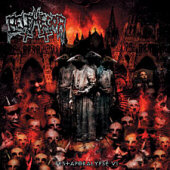
Here, at least one song still retains such pornographic intensity. 'Sanctus Perversum' encapsulates the core essence of Belphegor, but the subject matter is not done to death this time around. The band focuses on the link between the infamous Black Death plague that ravaged Europe in the Middle Ages, leading some Christians during that time to lose their faith in God before turning to Satan out of frustration, which is indicated by the mark on the foreheads of the congregation seen on the front cover. At least, that’s how I remember it from reading excerpts of the band’s interview not too long ago.
After all, the cover artwork is already an indication that "Pestapokalypse VI" is going to focus on something else instead of the usual speculum inside a nun’s rectum. On the other hand, you also have the Marquis de Sade-inspired 'Bluhsturm Erotika,' written in German to satisfy the inner sadist lurking deep within the recesses of your psyche.
Extreme expression is nothing without strong engineering and production. The fine-tuning has thankfully produced a competent output that extends beyond the mere need to be loud and to be heard. For an audio processing system that is not ready to take the beatings, fair warning: this album will rip your speakers apart. Within the concentrated unity of the songwriting, the compression creates minor clipping on each song that pushes not only your speakers but your ears to the limit. All instruments are audibly loud, perhaps way too loud, especially at a higher volume.
Again, it’s all calm during the storm to me. That might not be the case with everyone. After all, this kind of music is not meant to be comfortable to listen to; quite the opposite is true. Then again, to us fans, that’s exactly what we want with this kind of subversive art. It is meant to be provocative, and the band did a good job delivering just that.
Looking back, I realized that Belphegor has focused a lot more on slower, doom-like compositions. They can still dish out faster tracks at a whim even in 2026. Somehow, ferocity is a little subdued lately, relying a lot on extended double-bass sections on most of the songs on "Conjuring the Dead." Perhaps such a shift in pace could be attributed to Helmuth’s severe typhoid infection in 2011 and subsequent journey to recovery, which altogether might have taken a toll on his physique. Nevertheless, "Pestapokalypse VI" was and still is a worthy record that stands the test of time. I mean, 20 years later, I still am listening to this album.
Just some useless backstory on how I got a copy of this album: previously, I could only manage to collect .mp3s and .flacs, but recently, record stores are making a comeback in my country. The Mystic Production mediabook is yet another recent find upon visiting one of the record stores. Only two copies of this album were placed on the shelf, still sealed in shrink wrap with the hype sticker plastered on the top right corner, for a price of BND$30. I didn’t hold back as usual, grabbing the album along with the 2024 digipak reissue of "Scars of the Crucifix" and Metal Blade’s slipcover edition of "I Loved You at Your Darkest." Why not, right?
With the recent shuffling of cabinet ministers in our country, one of the things that has come into full force is the reinstated ban on heavy metal music and its subgenres. Alternative rock isn’t spared either; the latter is also included in the list of music genres banned by the local government. Yeah, it’s that fucking stupid. Go look it up if you think I am making this shit up.
As a conclusion, "Pestapokalypse VI" remains one of the best albums by Belphegor. I just don’t see enough reasons to justify why some people would hate this record. But I don’t speak for other people. To me, this album marked the point in time when the band evolved musically, and there was already a hint of things to come, particularly on the slower songs.
If this album is already in your collection, keep spinning it. If you haven’t, go now and buy yourself a copy; what are you even reading my review for?
Rating: 9.2 out of 10
1.08k