
Arckanum - Official Website
Fran Marder |
Sweden
 |
|---|
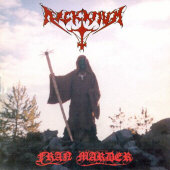

Buy on: Bandcamp
Type: Full-Length
Release Date: 1995
Label: Necropolis Records
Genre: Black
1.
Pans Lugbn / Hvila Pa Tronan Min
2.
þe Alder Hærskande Væsende Natur
3.
Svinna
4.
Kununger Af þæn Diupeste Natur
5.
Gava Fran Trulen
6.
Fran Marder
7.
Bærghet (De Glomda)
8.
Trulmælder
9.
Kolin Væruld / Ener Stilla Sior Af Droten Min
Review by Felix on June 18, 2023.
Let me tell you something that should be common understanding. These song-interlude-song-interlude-song albums do not work. Their configuration hurts their flow and their density massively. Pestilence’s “Testimony of the Ancient” is a good output, but it would be a great one without the big number of mostly senseless intermezzos, to give but one example.
And let me tell you another thing that should be common understanding as well. The guy with the pseudonym Shamatee was able to create very intensive, pitch black, occasionally almost magical music, at least on his first albums. “Kostogher”, for example, does not lack power or spirituality and it is one of the albums which confirm my statement.
“Fenris kindir” offers both senseless sequences where nothing happens (without having the strict configuration I mentioned above) and partly very good, fascinating and powerful music whenever the compositions gather momentum. “Hatarnir” with its rasping riffing, the nearly devastating bass drum and the hateful troll-vocals starts in a wonderful manner, but a needless break (shamanic whispering is on the agenda) leaves me perplexed. Again and again it happens that the actually vigorous material vanishes into thin air and I am just listening to the sound of wind, asthmatic trumpets which know only one tone or gypsy-like fiddling nobody ever asked for. Maybe this is a kind of soundtrack for a shamanic ritual (I am almost sure), but honestly speaking, I would have preferred a higher portion of metal instead. Aggravating the situation, even the metallic parts of “Fenris kindir” are not immune against weak moments. Some sections suffer from repetition, the songs are pretty similar to each other and the guitar tone transports a somewhat monotonous vibration the longer the full-length lasts. Nevertheless, this is the lesser evil compared with the overlong, boring intermezzos. The furious beginning of “Angrbođa” alone has more fire than all the interludes put together – not to mention the pleasantly sick screams in the background that appear as the song progresses.
The production is typical for Arckanum. Neither polished nor blurred, it creates this misty and opaque atmosphere the project has been well known for. Maybe it is true that the guitars are too loud in relation to the drums, but the voice has enough space. Anyway, I can recommend this output only to convinced weekend-shamans, because solid-to-good songs and an overdose of non-musical sections lead to a result that cannot compete with the real highlights of an overflowed market. I admit that there is still a form of primordial mysticism in the material. Unfortunately, sometimes too many conceptual thoughts are rather part of the problem than of the solution.
Rating: 5.6 out of 10
1.17kReview by Felix on February 7, 2021.
Arckanum was run by just one artist. Shamaatae mastered the instrument “everything”. In this comfortable situation, he did not need to discuss his ideas with anybody else. Instead, he just released a remarkable number of albums and then he went back to his cave and switched off the light. But it was a long journey from Fran Marder, the debut, to the final day of Arckanum – and this journey began promising.
Fran Marder deserves the attribute “monolithic”. It creates a dense, homogeneous and opaque atmosphere right from the beginning. Its single songs are important, of course, but the main focus is on the album as a whole. The storm breaks loose after the intro and nothing stops the artist from wallowing in endless, pretty cold guitar lines. The album from 1995 does not show the almost absurd level of total misanthropy and hostility that was captured on Darkthrones’s “Transilvanian Hunger”. But generally speaking, the approach of the here presented songs is not far away from the eight documents of vileness Fenriz and Nocturno Culto offered in 1994. 'Kununger Af Þæn Diupeste Natu', to name but one example, with its restless drums and the bloodthirsty guitar leads builds an easily recognisable connection to the pieces of the Norwegian classic.
Of course, the shaman acting here is close to nature. That is why there is not only the concentrated studio power of electric guitars, but also short interludes with rippling water and similar sounds. But of course, the sound of the album is determined by the guitars, which are – with the exception of 'Bærghet', a pretty strange number with fairly inappropriate melodic female vocals –exclusively performed at a rapid tempo. The rushed-sounding voice of the main protagonist (as well as the female vocals that also appear in 'Trulmælder') and the drums are not neglected, the rest plays no role. By the way, the extraordinary and impressive 'Trulmælder' proves evidence that the integration of a female voice can be a good idea, because here the melodic approach contrasts very well with the menacing wall of sound of the instruments.
The album is not overly atmospheric. The restlessly advancing guitar leads are like a skin of steel and Fran Marder almost sounds mechanized. But it is a well-oiled and effectively working machine I am listening to. Even though 'Bærghet' floats in its own spheres, the machine does not begin to stutter. The song material is simply too strong. No doubt, Fran Marder was a promising debut without lacklustre tunes. An interesting journey had begun. (Final note: the re-release of Debemur Morti displays eleven instead of nine tracks, but don’t expect bonus material. The difference is based on the fact that intro and outro are shown separately.)
Rating: 8 out of 10
1.17k