Megadeth - Official Website


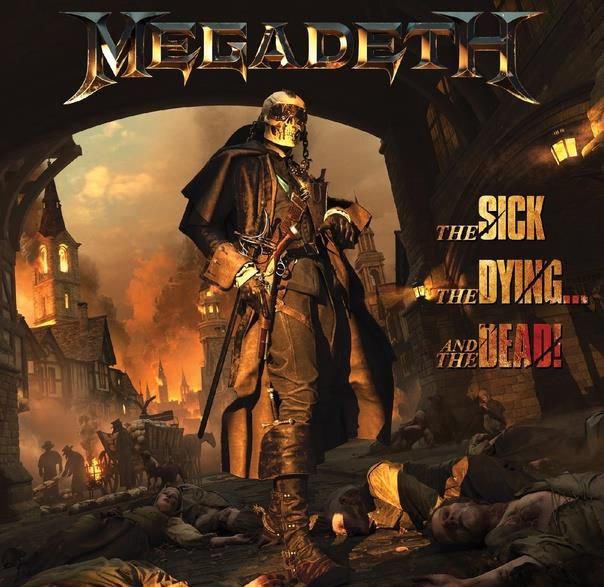
The Sick, The Dying... And The Dead!

United States Country of Origin: United States

1. The Sick, The Dying... And The Dead!
2. Life In Hell
3. Night Stalkers
4. Dogs Of Chernobyl
5. Sacrifice
6. Junkie
7. Psychopathy
8. Killing Time
9. Soldier On!
10. Célebutante
11. Mission To Mars
12. We'll Be Back


Review by Norbert on April 8, 2026.

In the theosophical tradition, an egregore is a collective thought-form—an entity arising from the accumulation of ideas, emotions, and imaginations of many people. The word itself derives from the Greek grēgoréō, meaning “to watch” or “to be awake,” and was popularized in the 19th century by Victor Hugo, later developed by occultists like Éliphas Lévi. In their view, egregores are not merely abstractions—they can gain power, influence reality, and even take control of those who co-create them. They are collective entities, emerging from patterns of thought repeated over and over again until they eventually take on a life of their own.

And this is precisely how the music of the Canadian band Egregore works. The Vancouver trio’s second album, released on March 20th,2026, is difficult to categorize, as It Echoes In The Wild sounds like the result of a clash of multiple aesthetics and ideas that, over time, have coalesced into a single, autonomous whole. This album is dense, complex, and full of unconventional ideas, demonstrating from the very first minutes that we’re dealing with a band that thinks more in terms of form than pure aggression. At the same time, it’s not art for art’s sake—alongside twisted structures and sudden turns, there are also more direct moments built on catchy riffs and a solid rhythmic backbone.

Behind this material are musicians known from Auroch, Garotting Deep, Mitochondrion, and Atemporal, which is clearly audible in the way the songs are constructed. The playing is technical yet uncluttered, brutal yet spacious, leaving room for dynamics and breathing space. Morbid Angel seems to be the most important point of reference here, particularly in the way riffs are developed, and that characteristic, slightly “cosmic” atmosphere is built. At the same time, Egregore go further breaking down classic structures and blending them with a more contemporary approach, closer to Ulcerate or Deathspell Omega. Departures beyond death metal territory are common, with moments reminiscent of late Mayhem, progressive passages in the vein of Opeth, or the technical ferocity of The Chasm.

The album opener, 'Cast Adrift,' effortlessly builds tension and outlines the palette of techniques the band will explore further, while 'Voice On The West Wind' plunges the listener into controlled chaos. The riffs change almost constantly, the tempo undulates, and the whole feels like an organism in constant motion—as if successive ideas were overlapping and mutually reinforcing.

The album’s great strength lies in its dynamics. Alongside dense, almost suffocating passages, more open—even melodic—sections emerge, capable of elevating the songs to completely new heights. 'Stair Into The Vortex' strikes a more direct chord with a distinct thrash edge, while 'Craven Acts Of Desperate Men' and 'From The Yawning Crevasse Shrieks A Transmorphic Gale' develop into longer, more narrative forms full of shifts in tempo and mood. The vocals are a key element—varied and shared between all band members. From deep growls, through whispers, to high-pitched, almost Halford-esque screams (including a distinctly King Diamond–like passage), they introduce additional anxiety and drama. Instrumentally, everything is of a very high standard: the guitars balance between chaos and control, the drums are intense and precise, and the bass remains clear and present throughout. The raw yet transparent production conveys the complexity of the material well.

Despite the sheer number of ideas, everything holds together—nothing sounds haphazardly assembled. Individual tracks act as successive layers of the same structure, amplifying its power through repetition and transformation of motifs. In this sense, It Echoes In The Wild functions precisely like an egregore—the result of accumulated energy, ideas, and inspiration that together create something greater than the sum of its parts.

This is a demanding yet captivating album, revealing new details with each listen. For me, it’s—so far—my favorite death metal release of the year. Egregore demonstrate that extreme metal can still be a field for exploration, not just the replication of tried-and-true patterns.

Rating: 9 out of 10

   1.55k

Review by Fran on September 19, 2022.

When I was younger I wasn't really a fan of Megadeth; I thought their style was too close to traditional heavy metal, so slower than Slayer and I had a need for speed. A couple of years ago I revisited their first albums, Peace Sells... was ok but I didn’t love so much blues on the basslines and groove in general. So Far, So Good, So What seemed a little bit better but was somehow shadowed by Rust In Peace, that strikes you from the first time you listen to it. Technical and ambitious songwriting, excellent string instrumentation overall. Countdown To Extinction is more laid back, I wouldn't say it's melodic because it isn't as cheesy and pompous as let's say... power metal; but the use of harmonic tension is intelligent, it helps to develop a dark and chilling atmosphere. On The Sick, The Dying And The Dead I found a collection of the very best moments of those classic albums, surprisingly.

I noted the personnel change at first, long time bassist Dave Ellefson was replaced by Steve DiGiorgio. In terms of composition it implies a purge of the classic groovy basslines from the former but at the same time it doesn't sound like a record done by SDG, I assume he was told strictly what to play so the bass lines are pretty simple and just serve as a mattress for the guitars, totally relegated on a second plane. You can hear the bass but even on the mix it isn't as loud as on "Individual Thought Patterns" by Death or "Defiant Imagination" by Quo Vadis. I read on an interview with drummer Dirk Verbeuren that his drum parts were initially developed by Dave Mustaine in terms of which was the pace and the rhythmic tension most appropriate for each part of the songs, and latter he perfected the fills and breaks with his drumming skills. That being said, this is one of the richest albums of Megadeth in terms of percussion; it is modern, precise and aggressive. Dirk also wrote the main riffs from 'Life In Hell' and another riff from 'Nightstalkers'.

The guitar work is outstanding as you can imagine, prime Mustaine with lots of twists but never losing the edge. The fast numbers like 'The Sick, The Dying And The Dead', 'Life In Hell', 'Nightstalkers', 'Célebutante' and 'We'll Be Back' are complete bangers with vicious riffing and virtuosic soloing, double bass hammering on the drums and everything. The rest of the album is mid paced, heavier and leaves room for a little bit of experimentation like the eerie guitar intro of 'Mission To Mars' which is kind of progressive and space-like. 'Dogs Of Chernobyl' features an acoustic intro with metallic strings that sounds super cool, proving Dave is still a hell of a guitarist. There’s another interesting breakdown in 'Nightstalkers' at the end of the piece, with orchestral arrangements that sound straight outta Compton… I guess that was ICE-T’s collaboration. Summing up, this is Megadeth’s best album in 30 years and it’s completely on par with their beloved classics and other thrash metal staples; if you love classic thrash and traditional heavy metal you’ll definitely like this.

Rating: 9.5 out of 10

   1.55k