
Kyūketsuki - Official Website - Interview
Oni |
United States
 |
|---|

Buy on: Bandcamp
Type: Full-Length
Release Date: March 8th, 2025
Label: Independent
Genre: Ambient, Black
1.
Oni(rique) I - The Son Of Death
2.
The Great Genna Martyrdom
3.
Devilman
4.
Gemini
5.
Oni
6.
Tomie
7.
Uzumaki
8.
Arubeki Jigoku
9.
Oni(rique) II Stigmat
Review by Jerome on November 19, 2022.
Chaotic is a term frequently used by the uninitiated of extreme metal to describe aggressive, noisy or music slightly out of their comfort zone. It is indeed difficult to reproach them with such a description when these musical genres want to be transgressive by their very nature. Nevertheless, this description is limiting and sometimes too generalized.
A more experienced ear will indeed be able to identify the subtleties between a group that relies on an atmosphere derived from the repetition of a few chords or a group that relies more on standard structures like the famous rondo. For some bands, however, such as the American band Imperial Triumphant, we have to admit that as limiting as it may be, chaotic is the most appropriate word to describe their music. This New York group integrates key concepts to the "free jazz" style such as improvisation, experimentation, transgression and the accentuation on the timbre rather than the note. The result is a music that describes itself as well as the megalopolis inhabited by the trio; frenetic, dynamic and dizzying.
Their fifth album, Spirit Of Ecstasy is the last of a trilogy where one could roughly describe their musical genre as a meeting between experimental death/black metal in the style of Portal or Deathspell Omega and free jazz in the style of the great Charles Mingus. Although this is the second album distributed by Century Media, the sound and musical structure are more reminiscent of the album Vile Luxury where the band revealed, for the first time, in a rather explicit way, its links with the jazz universe. We find there a more organic approach much closer to the free form style than Alphaville where the rather methodical and technical approach typical of metal was more present.
The use of jazz influences can be found not only in the few interludes where we can distinguish the presence of trumpet, trombone and even saxophone (such as the solo performed by one of the most famous musicians in the smooth jazz scene, Kenny G., in the middle of the piece Merkurius Gilded) but also in the composition. Indeed, from the first bars of the piece 'Chump Change' we find ourselves in a dissonant universe where the drums don't follow any recognized structure and atonal chords produced by the guitars. The vocals used in this album can be, once again, compared to the style appearing in the discography of Deathspell Omega, a hybrid vocal style, located between the scream of type ''fry scream'' characteristic of the black metal style and the ''growl'' more common in the death metal.
The mixing of the album plays a very big role in the musical experience that Spirit Of Ecstasy offers. The album alternates between the use of echo and reverb effects to give the illusion of space and volume (the second half of 'Tower Of Glory', 'City Of Shame') and white noise in conjunction with the palm mute of the guitar to give a claustrophobic feeling ('Metrovertigo').
The result is a feverish and chaotic experience where atonality and dissonance reign supreme. Whether it is for neophytes or for extreme metal fans, this album will take many out of their comfort zone. Although Imperial Triumphant remains consistent in their innovative, deconstructivist and primitive approach, their music remains difficult to access and approach for those who do not fit into the avant-garde genre.
I would certainly recommend the album to fans of the unexpected, to those interested in avant-gardism and for the most adventurous of metalheads. For my part, I recognize the innovation and the ambition of such a project. It seems clear to me that Imperial Triumphant pushes the limits of extreme metal and that the album Spirit Of Ecstasy cements this New York band among the great acts of avant-garde music. However, I have to admit that I can only leave this chaotic, disjointed and certainly bizarre music to those who are more interested in this scene.
Rating: 8 out of 10
(originally written in French for metalalliancemag.ch)
2.98kReview by Fernando on April 12, 2025.
Black metal is a style of music that isn’t unfamiliar with dark themes and shocking imagery. The whole genre is predicated on exploring the darkest aspects of religion, nature, and humankind, for better and worse from a variety of angles and also a variety of sonic styles. And sure enough, some bands that go in more pagan directions use folk instrumentation to further create a sound that matches the lyrics and aesthetics. With all that in mind, then allow me to introduce Kyūketsuki (Key-ew-ket-ski); one of the many musical projects of multi-disciplined artist Maxime Taccardi, aka Yūrei.
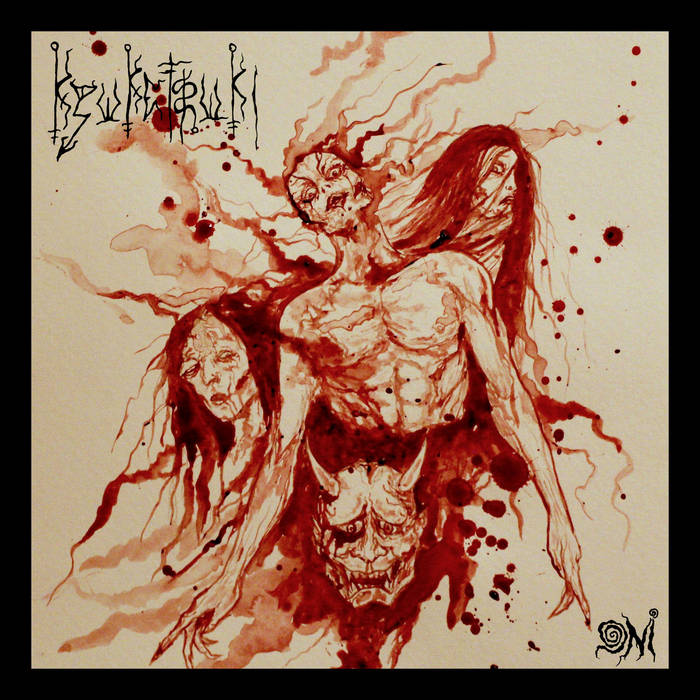
Taccardi is no stranger to black metal, he’s mainly known for his nightmarishly hypnotic artwork that has graced the covers of many bands, some with ink and acrylics, others with his own blood. However he’s also a prolific musician, having various projects that are within the vast spectrum of black metal, however, Taccardi’s style is as distinct and unique as his artwork, and Kyūketsuki is no exception. This particular project was started in 2020 and what makes it unique is how it mixes Taccardi’s particular style of raw black metal with dark ambient, horror soundscapes and most importantly; Japanese folk instrumentation, with the lyrics and aesthetics also focusing on the darker side of Japanese folklore, poetry, and even horror movies, manga (Japanese comics) and anime (Japanese animation). And in 2025, Taccardi, under the Yūrei moniker released the newest Kyūketsuki album simply titled Oni.
From my previous description of the project's music, what you can expect is some truly sinister, dark, and even disturbing, while also pushing boundaries into realms beyond black metal. And since this is the project’s eighth album, there is a complete mastery and refinement of the various influences. One thing I do want to highlight is in regards to the black metal influence of the music; you do have the more obvious signifiers; incessant blast-beats, distorted guitars, a dark and unrelenting atmosphere, and screeching vocals, however, black metal is simply the sonic foundation for the project, the focus isn’t on riffs, moshing or brutality, it’s on atmosphere, the album at points does become pure dark ambient and the guitar and bass take serve as textures in the form of drones and noise.
The most distinct instrument you’ll hear in this record is the xylophone, and it creates both a sense of unease as well as a contrast with the rest of the more noisy and abstract instrumentation, however, while the xylophone is widespread throughout the album, the rest of the instrumentation is nothing to sneeze at. The percussion is the most fascinating as Taccardi uses blast beats in tandem with taiko; a Japanese drum and the result is ominous percussion that creates depth but also a sense of claustrophobia which is then paired with the droning strings and various synths, samples, and Taccardi’s distinct ghostly vocals to create an oppressive but hypnotic display of sonic terror wherein you’re gonna be disturbed but you can’t press pause.
The final aspect I wanted to mention is the lyrical topics of this record because they’re paired with Taccardi’s blood art. Each song has a corresponding piece of artwork which also encapsulate the vibe, and the most interesting songs are the ones based on modern Japanese media; the tracks 'Devilman', 'Gemini', 'Tomie' and 'Uzumaki' break away from Japanese folklore, history, poetry and beliefs but are no less significant or essential to that country’s culture; 'Devilman' is based on the seminal manga of the same name by Go Nagai, that’s still referenced in Japanese animation to this day, 'Gemini' is based on the movie of the same name by cult filmmaker Shinya Tsukamoto, and the last 2 songs are based on the works of acclaimed horror manga artist Junji Ito; aside from all these men being considered modern luminaries of Japanese art and film, the specific works that Taccardi was inspired to based his songs perfectly fit with the project’s aesthetics and themes as a whole, since they’re distinctly Japanese and reflect a modern perspective on that country’s folklore, so there’s an excellent conceptual execution wherein Taccardi displays both ancient folklore with modern folklore.
Overall, this is a fascinating album and project to delve into, while I wouldn’t recommend it to everyone, be they adherents of traditional black metal with European sensibilities, or the uninitiated who may be put off by both the relentlessly dark music or the disturbing artwork, it’s still a record and project worth delving into, it’s both a unique departure from black metal and a masterful synthesis of dark music that pushes boundaries to create something unique and unlike anything else out there.
Rating: 9 out of 10
2.98k