
Sothoris - Official Website
Domus Omnium Mortuorum |
Poland
 |
|---|
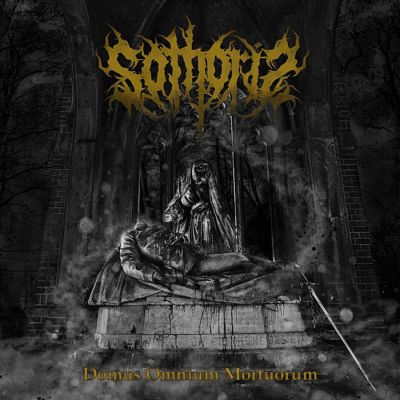

Buy on: Bandcamp
Type: Full-Length
Release Date: October 3rd, 2025
Label: Fetzner Death Records
Genre: Black, Death
1.
Wieczornica
2.
Szkarłat
3.
Lawa
4.
Bylem Faustem
5.
Dzieci Diabła
6.
Pro Memoria
7.
Dym
8.
Piętno
Review by SzejkElRopa on February 27, 2026.
One day, there was a concert that was taking place in a relatively close proximity to where I live. Four bands were playing, and two of them were Zmarłym and Varnheim. As I mentioned in my other reviews, I especially like their latest albums, and I would be delighted to see them. Unfortunately, I was coming back from a long trip, and being extremely tired, I decided not to go. The reason why I am even mentioning that concert is that two other bands were playing - Fiasko (which I am not familiar with yet) and Sothoris, which were likely presenting their latest album - "Domus Omnium Mortuorum" (in Latin: "House of all the dead"), and after listening to it, I regret missing this concert even more now.
This quintet from the small city of Miłosław in Greater Poland plays a style that can be classified as blackened death metal. The death metal side excels at growl vocals and heavy, crushing riffs that appear intermittently, for example, in the middle section of 'Dzieci Diabła', and obviously many other songs. Although there are certain death metal elements, this is not everything Sothoris has to offer. For instance, the dynamic riff opening 'Pro Memoria', my favorite track, is closer stylistically to black rather than death metal. It is absolutely neck-breaking, especially combined with a vehement yet catchy chorus. Moreover, in the middle sections, tremolo riffs appear quite commonly, for example, in the opening 'Wieczornica'. Most of the time, elements of both genres take turns. One of the elements that makes this album special is the spoken narratives that appear sporadically. In 'Byłem Faustem', the song suddenly stops to introduce a person speaking an excerpt from Mickiewicz's "Dziady". This mysterious speech is accompanied by a soft guitar playing in the background, which evokes additional mysticism to this heavy album. The same can be said about the beginning of 'Lawa', although the narrative lasts shorter. The album isn't kept in one tempo all the time; for instance, 'Dym' is mostly played mid-tempo or even slow compared to other songs on the album, namely the aforementioned 'Pro Memoria'. Other songs, such as 'Szkarłat', change tempo from fast to slow, depending on the part of the song.
The best aspect of the album for me is the guitar solos. They are put perfectly in place, are different from each other, and convey the most amount of atmosphere. Starting with 'Szkarłat' - the solo appears after the song builds tension to it. It is equally brutal and melodic; it sounds similar to the opening of the song. On the other hand, the solo in 'Dzieci Diabła' is more melancholic and melodic than the solo in 'Szkarłat', and also fits the song, due to it being less brutal. Lastly, in 'Byłem Faustem', the melodic section close to the end of the song is also slightly melancholic. The riffs vary from calmer to heavy and hard-hitting. One of the highlights is the melancholic middle section in 'Lawa', which, again, adds to the atmosphere of this album. Also, the opening of 'Dzieci Diabła' is very memorable due to its quite complex riff. In 'Lawa', the chorus is accompanied by another catchy, melodic tune, yet it doesn't fall into the trap of over-melodicity. The vocalist operates with black metal-ish harsh vocals and typical for death metal growls. Although his contribution to this album is quite heavy, his performance doesn't get tedious with time due to the spoken narratives and various styles. The drumming is solid and well-produced, even though not particularly groundbreaking. Hrist showcases a dynamic performance, blastbeating when necessary, using cymbals very often, and in general, keeping the good quality of the album. The production is clear, yet not sterile. Its rawness helps with transferring the wickedness onto the listener, but in a way that every instrument is clearly heard, except for the bass guitar, which was somewhat buried in the mix.
The lyrics are mostly about the idea of Polish Messianism. Messianists in the 19th century thought that Poland, like Jesus Christ, would suffer for Europe's sins, and in the future, would be back independent on the map. The lyrics also mention human wickedness during the Spring of Nations, as well as criticise corrupt priests ('Dzieci Diabła'). The spoken narrative in 'Byłem Faustem' is the excerpt from the third part of Mickiewicz's "Dziady", and it is a part of the main character's monologue to God. Konrad, because that's his name, tries to rebel against God, picturing himself as the person who, despite his limited power, attempts to challenge God and place himself on equal footing with Him. 'Lawa' is also a reference to "Dziady". In the original drama, lava is compared to the Polish nation. The outside part, which is cold, was compared to the older Polish people, who didn't want to be Polish anymore. The hot inside part was compared to the young people, who were patriotic and wanted to fight against the occupying Russians. It is quite interesting that Metal Archives talks about Satanism and Anti-Christianity in themes, because, except for 'Dzieci Diabła', which is more an anti-corrupt priests song rather than an anti-Christian/anti-Church song, there are no Satanic references in this album at all.
"Domus Omnium Mortuorum" proved to be an extraordinary album that successfully blends death metal heaviness with black metal atmosphere, implementing themes from Polish literature and history. Although not every song was as good as 'Pro Memoria', and the whole album wasn't equally good for the whole 45 minutes, the strengths clearly outweigh the flaws. As for the time of writing this review, the video of it on YouTube has only 8,5k views. It undoubtedly deserves more! I confidently give this album 9/10 - the number of views certainly doesn't reflect the quality of this release. Recommended especially for fans of blackened death metal with Polish lyrics, and this genre in general.
Rating: 9 out of 10
1.55k