
Ch'ahom - Official Website
Anthropic Rites Of Sublimation |
Germany
 |
|---|

Buy on: Bandcamp
Type: Full-Length
Release Date: September 18th, 2026
Label: 20 Buck Spin
Genre: Black, Death
1.
Cult Of Xaman
2.
Reign Of Nohol
3.
Priests Of Lik'in
4.
Chosen Of Chik'in
5.
Insemination
Review by Norbert on October 4, 2026.
Chahom? Cza-hom? Cza'om? Or perhaps Ch'a-hom, with a brief glottal stop somewhere in the throat, as if the word itself needs to be stifled for a moment before being allowed to resonate? Ch'ahom looks like the kind of word one shouldn't utter without first knowing, well, what exactly? A ritual, perhaps? But what is Ch'ahom? The name of a deity? A demon? A place of sacrifice? None of these, although the intuition pointing toward ritual turns out to be remarkably accurate. The term derives from the Mayan language and is associated with a person performing a ritual function, someone who offers or scatters incense, a "maker of smoke," a participant in ceremonies standing somewhere between the earthly realm and that which can only be sensed. It is difficult to imagine a name better suited to a band whose music has always seemed less composed than performed as a ceremony.
Ch'ahom formed in Essen, Germany, in 2015 and remained an underground phenomenon for a long time. Before emerging from the depths with their debut album, Knots Of Abhorrence, in 2023, they spent years spewing out one demo after another: "The Raid Of The Tzitzimime," "Oblation," "Path To Ixtab," and "Lustfully Sinning For Death Metal," as if they were not building an ordinary discography but unearthing successive fragments of something far older. Some of these recordings later appeared on the compilation "Camazotz Cult," while subsequent releases documented the gradual transformation of primitive, bestial black/death metal into something increasingly psychedelic, progressive, and ritualistic. Anthropic Rites Of Sublimation, released last Friday, is only the Germans' second full-length album (although more than one grumpy metalhead will undoubtedly scoff at its running time of less than thirty minutes), but it is certainly not the second chapter of this story.
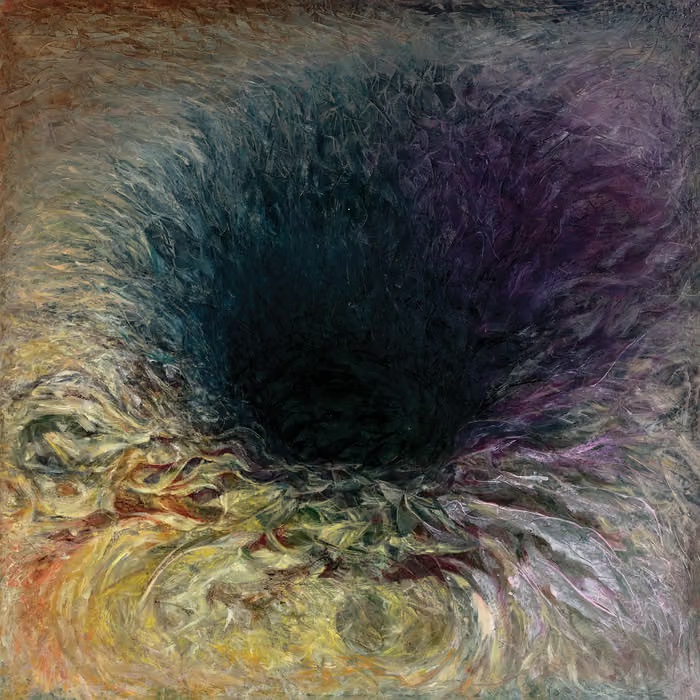
With Ch'ahom, even the titles seem to lead downward. The EP preceding the album was called Ts'ono'ot, and that is where we must look for the direct entrance into the world developed on Anthropic Rites Of Sublimation. The name refers to a Mayan term associated with cenotes, natural wells and sinkholes formed in limestone terrain. Here, however, such a fissure in the earth becomes something far greater and considerably less natural. The story begins at the edge of a cenote of almost unimaginable proportions, a cosmic wound whose call draws the lost toward self-annihilation. Four civilizations emerge around it, each creating its own rituals, hierarchies, and monuments in an attempt to give meaning to something beyond comprehension. The urge toward death is thus transformed into religion, religion into social order, and the fear of nothingness into the foundation of culture. Mutilation, slavery, the sacrifice of others, and the voluntary surrender to the abyss cease to be aberrations and become elements of an established order. Once again, humanity does what it does best: erects a monument over the precipice, assigns meaning to it, appoints priests, and convinces itself that by creating a ritual, it has also understood what awaits at the bottom.
On Anthropic Rites Of Sublimation, Ch'ahom attempt to give this abyss a sound. The Germans' black/death metal remains brutal, primitive, and hostile, but considerably stranger things are happening beneath the surface. Guitars veer into side passages, riffs deform as they unfold, rhythms suddenly lose their familiar shape, and solos briefly emerge from the tumult before disappearing again. There is war metal fury, death metal heaviness, and a progressive logic resembling the architecture of a structure whose layout becomes less comprehensible with every new room. Ch'ahom are still perfectly capable of swinging a sledgehammer, but things become considerably more interesting when they start arranging the rubble. Compared to Knots Of Abhorrence, the music has become more accessible, but that doesn't mean anyone has switched on the lights. Quite the opposite: it is simply easier now to see how deep the stairs go. The compositions are compact, yet almost constantly shifting shape. A blast beat is interrupted by a broken groove, a massive riff crumbles into nervous figures, the picking and time signatures change, and then the band plunges back into a bestial gallop. 'Reign Of Nohol' and 'Priests Of Lik'in' are particularly good examples of how effortlessly the Germans move between brutality and technical detours. One might detect traces of Timeghoul, Gorguts, Profanatica, or early Blood Incantation, but Ch'ahom seem to have moved beyond sounding like the sum of their influences. They have molded their own deity from them.
What happens between the successive eruptions is equally important. Bells, whistles, tribal rhythms, distant voices, and ancient instrumentation are not exotic decorations tacked onto the guitars. They are what allow the album to breathe a different kind of air. When the noise subsides, there is no sense that the music has truly stopped. Rather, the ceremony continues somewhere beyond a stone wall, and all we hear is its reflection. The reverberation amplifies the impression of an immense subterranean space, from which archaic sounds emerge like echoes of a buried sanctuary. This is precisely why Ch'ahom's ritualistic approach works. It takes more than arranging a few bells, lighting some incense, and adding an ambient intro to announce to the listener that a ceremony has begun. Here, ritual is woven into the very way the music functions. Recurring figures resemble incantations, sudden rhythmic changes suggest successive stages of a ceremony, and the quieter passages offer no relief whatsoever. Quite the opposite, in fact. When the wall of guitars disappears, there is no silence behind it. There is space. And something in that space seems to be waiting.
The five tracks comprising Anthropic Rites Of Sublimation are perhaps best approached as a single ritual. There are few "choruses" or riffs that insist on being remembered. Motifs appear, transform, and disappear before we can get hold of them. The first four compositions introduce successive cultures that have arisen around the abyss, but all corridors eventually lead to 'Insemination,' a closing track lasting over ten minutes and occupying almost a third of the album. This is not so much a climax as a descent into a place for which the preceding songs were merely antechambers. Ritual chants, atmospheric voids, peculiar harmonies, and twisted riffs are eventually swallowed by another wave of violence. The music thickens, loosens, attacks again, and carries us further and further until, suddenly, everything ends. No grand gesture, no triumphant finale, and no safe passage back to the surface. As if someone had extinguished the torch.
Perhaps this is why the less-than-half-hour Anthropic Rites Of Sublimation feels longer than its running time would suggest. The five compositions resemble five exposed chambers of a structure whose remaining sections are still buried underground. Beneath all the pre-Columbian imagery, psychedelia, and extreme metal, however, lies an idea far older than any of the civilizations invented by Ch'ahom. Humanity knows it will die, yet can almost never leave that knowledge alone. It must surround it with gods, rituals, art, violence, or hope. It must find meaning, or at least create the shape of one. Ch'ahom propose a world in which this mechanism is pushed to its macabre conclusion: entire societies arise on the edge of annihilation, making it the foundation of their faith and culture.
Perhaps the most unsettling possibility, however, is that the cenote need not be a metaphor for death at all. It may be something considerably worse. Something that truly exists down there and has been waiting patiently for someone to appear at its edge, someone capable of hearing its call. If Ts'ono'ot was a glimpse over the precipice, Anthropic Rites Of Sublimation is the descent itself. And when the final sound fades, Ch'ahom leave us with a question better left unasked: did we descend of our own free will, or was something calling us from the very beginning?
Rating: 9 out of 10
66