Baalzagoth - Interview
Four years after the release of their well-received debut, "Morbid Persecutions", Baalzagoth return with their second album, one that not only develops the band's characteristic sound but also clearly defines their identity. "No God, No Savior" is a more conscious, mature, and compositionally daring effort, while remaining firmly rooted in uncompromising old-school death metal. There is no room here for chasing trends, technical showboating for its own sake, or calculating moves based on market expectations. Instead, we get an album built around atmosphere, strong emotions, and a clearly defined message. The new songs draw both on the experience gained from playing live shows in support of the debut and on the musicians' growing confidence. Alongside direct, brutal compositions, there are also some less predictable ideas. The lyrical content plays an equally important role. This time, Baalzagoth put even greater emphasis on their anti-religious message, turning criticism of religious institutions into an open declaration of principles. I spoke with Asmodeus (bass) and Oktavius (vocals) about the making of the album, live influences, the band's internal dynamics, and the meaning behind its title.
Levi

Four years have passed since the release of "Morbid Persecutions". When you look back at that material today, what thoughts come to mind? Did the debut accomplish what you wanted it to and help Baalzagoth establish its place on the death metal map?
Asmodeus: Hey Levi! First of all, thanks a lot for inviting us to this conversation. Looking back, "Morbid Persecutions" is a very important album for us for several reasons. First, it was an artistic and personal breakthrough for all of us. Before making it, none of us had even imagined that we would record an album in a professional studio with one of the best producers in the business. The final production and the reception it received exceeded our expectations.
Second, it gave us invaluable experience and the opportunity to see exactly how the recording and production process works. And third, there was the reception itself. It was extremely positive, whether we were talking about comments on the internet or the things people told us after concerts. It went beyond our wildest expectations. I'd like to take this opportunity to thank everyone who comes to our shows and has something good to say about us. A huge thank-you to all of you!
That said, we also look at the album critically. Both on our own and through the criticism we've received from others. Speaking for myself, I think it could have used more madness, more unpredictability. At times, there's a little too much space in those sounds and not enough of a kick in the ass. Nevertheless, the debut definitely accomplished its mission, and I believe the pin bearing Baalzagoth's black flag has been firmly attached to the death metal map.
Oktavius: Hailz, Levi! I'm the kind of person who's rarely satisfied with anything, especially my own achievements. By the time we'd finished the first album, I was already sniffing around for things that could have been done better. It's exactly the same with "No God, No Savior". There are a few things we didn't quite pull off, and a few things didn't go the way we'd planned. But I'm aware that you can keep torturing yourself over that shit until the end of your life. You simply have to know when to let go.
As for whether we've established our place on the map, perhaps we have, but the coming years will probably tell us that. I hope we have. A human being is like an animal: there's a need to piss on your territory so everyone knows you've been there or that it belongs to you.
You played quite a few shows while promoting your debut. I get the impression that the experience gained onstage had a considerable influence on the shape of "No God, No Savior". Extreme metal is at its best when experienced live. Would you agree? And when composing the new material, did you already have its live potential in mind?
Asmodeus: That's a very accurate observation, Levi. It probably comes from your experience, but we also know from your writing that you're a great observer of the scene. The lessons we learned from performing songs from "Morbid Persecutions" live absolutely influenced the shape of "No God, No Savior". We wanted to turn things up a notch and make everything heavier and more intense.
I think that although the music itself plays the most important role in all of this, concerts offer an opportunity for a much deeper emotional experience. They can ultimately convince people to get into a band, buy an album, or pick up a T-shirt. When creating our second album, we wanted people who came to our shows already familiar with the material to have a great time, whether they were going wild in front of the stage or simply watching and listening. And if someone had only heard the album through streaming, we wanted them to be convinced to buy a physical copy, because that's where this tar really bites the hardest.
We've already had some opportunity to test its live potential. The "No God, No Savior" songs we've managed to perform so far seem to have been received positively.
Oktavius: First and foremost, we absolutely love playing concerts. Maybe we don't do it as often as we'd like, but that's down to various circumstances and other commitments. Generally speaking, concerts give us a chance to let loose and bond with people. In most cases, the synergy with the crowd in front of the stage is intense.
There's another aspect to it (hehehe): we also like having a good time and partying. Our library of experiences from the road keeps growing through firsthand experience. :) All of that fucking has to find its way into the creative process, and generally speaking, it does.
Let's move on to "No God, No Savior". It definitely gives the impression of an album recorded by a band that knows exactly what it wants. It's not simply about improved musicianship, but above all about greater compositional awareness and a more clearly defined identity. It's still dirty, blasphemous, uncompromising death metal, but there's also more room to breathe, more interesting ideas, and a stronger sense of individuality. I got the impression that you had a very specific vision of what this album should be even during the songwriting stage. How did the material develop into its final form?
Asmodeus: Personally, I've never been a fan of creating concepts for entire albums. I think that's like putting a creative yoke around your own neck. I've also always believed that an album is most interesting when it's a collection of different songs, with each song being a concept in itself.
It's reviewers who came up with terms like "cohesion," whereas I consider that an absolutely secondary matter. Of course, there are certain things we can't escape. A collection of songs recorded in the same studio, using the same equipment and settings, by the same hands, feet, and throats, is naturally going to sound somewhat uniform.
When writing a song, none of us was thinking, "I'll do this in such a way that it remains cohesive with another track." But there's another thing we simply can't escape: every single one of us is thoroughly pissed off by what religion and the Church do to people. We play and sing in total opposition to that, and that may be another element that naturally contributes to the overall coherence of the vision.
Identity develops over time, just as a person grows up, matures, and develops. The same goes for a band. Baalzagoth is a few years older now, and our identity and character are definitely taking shape. The final form is largely Oktavius's doing. The guy carried all of this along a long and winding road, and I think the final result is good. But it's not really my place to judge it publicly. Let's see what the listeners have to say.
Oktavius: Well, I see it from a slightly different perspective. From the very beginning, I had a broader vision and a lot of thoughts concerning the new album. These are two separate things, because diversity in compositions absolutely doesn't rule out the idea of a concept. For me, it was a concept from the very start. Obviously, it became clearer as the writing process progressed. On one hand, the guys were concentrating on individual elements, while on the other, I was pushing many things in the direction I considered right.
Generally speaking, there's no democracy in Baalzagoth. Everyone can express their opinions and throw in ideas, and everyone has their strategic role in the band, but the decisions are still made by the Council of Decrepit Baboons, meaning Asmodeus and me. The guys trust us. We're a fucking family. But democracy? No way! Democracy has already destroyed plenty of bands.
I also have to point out that Asmodeus and I are something of a yin and yang. He's an incredibly patient guy. When I go for the jugular, he steps in with his diplomacy, much like Corleone. I have a pretty short fuse and tend to blow up quickly. Thanks to him, there's balance within the group. We all share a very specific bond, much like a family.
Since we're talking about new ideas, I'd like to stop for a moment at 'Auto-da-fé.' This track seems to go somewhat beyond the boundaries established on "Morbid Persecutions" and reveals a more adventurous side of Baalzagoth. Could a song like this have been created a few years ago, or is it the result of the band's natural evolution?
Asmodeus: 'Auto-da-fé' came about for several reasons. We wanted something on this album that would surprise people, throw them off balance, and at the same time offer a little breathing room through its different character. There will certainly be different opinions about it. I've already heard one: "What the fuck is this doing here?" Hehe. But this song absolutely had to be on the album.
Most importantly, it was written by someone from outside the band: Michał Sobczyński, who runs a music school in our town, where our guitarist Veles and drummer Vultur began their musical journeys. We wanted not only to enrich the album but also to thank Michał.
We had another idea as well, but we didn't manage to bring it to life. Hopefully, we'll be able to do that on the next album.
Oktavius: I have to admit that this one's my fault. I've had this kind of track in mind for a long time. I like these sorts of atmospheric passages. Morbid Angel introduced similar elements on "Blessed Are The Sick". You get your ass kicked for most of the album, and then something like this suddenly comes along. Hehehe. That's exactly what this track is supposed to do: break things up and draw you in with its atmosphere.
I'm fully aware that it won't appeal to everyone. When Filip first heard it in the studio, he simply said, "What the fuck is this, and what am I supposed to do with it?"
The song was written for us and recorded by our friend Michał Sobczyński, a musician who has absolutely nothing to do with metal. That was precisely the idea. Michał recorded practically all the instruments, including the strings. Ika Klimaszewska also contributed soprano vocals. That's when I came up with the idea of using Ika for vocal samples in other tracks as well.
You see, I have an incredibly broad range of musical interests. I'm friends with a few coyotes, none of whom listen to metal. One is an old Cure fan, constantly searching for atmospheric sounds. Another is a Depeche Mode fanatic who loves Cold Wave and old Synth-Pop. The third doesn't see anything beyond Pearl Jam and Tool.
I discovered metal together with my younger brother back in the late '80s. I've absorbed all kinds of different music over the years. On the previous album, we also had various samples and atmospheric elements, but those were added as we went along in the studio. The new material was created with a specific direction in mind from the very beginning. 'Auto-da-fé' was always supposed to be part of it, although I didn't initially know exactly what form it would take. It all evolved beautifully on its own.
I like the fact that you don't try to chase trends or break speed records. Instead, you've created an album that works primarily as a cohesive whole and builds its own atmosphere from beginning to end. Can "No God, No Savior" be regarded as a complete concept?
Asmodeus: I actually touched on this subject earlier by accident, haha. Although it wasn't something I consciously had in mind at any stage of making the album, when I finally pick up the record, open it, look at the cover—which is part of a broader picture—as well as the photographs and artwork, and then listen to the music, I feel a certain satisfaction hearing what you've described in your question.
The album's cohesion is the result of free, unrestricted art that lives inside us and that we want to share. It's not some calculated product designed to achieve a particular effect or a cookie-cutter creation made from a template.
There will never be virtuosity or speed records on Baalzagoth albums, although there is one moment when Vultur insisted on playing a blast beat at... some tempo, I don't remember exactly. But the number of attempts and the look on his face during the recording suggested that it was right at the limit of his abilities. That's just an episode, though.
As for trends, that's definitely not our thing. Baalzagoth is old school, and even if that means we won't attract a wider audience, that's how we'll remain, at least as long as old bastards like me, Oktavius, and Camasothz are playing in the band.
Oktavius: I'm glad you noticed that. Trends don't interest us at all. We do our own thing, our own way. If we make mistakes, they're our mistakes. Asmodeus, Camasothz, and I are old, couch-dwelling Satanists. Hahahaha.
Joking aside, we've been living and breathing metal practically since its beginnings, and I think you can hear that in our music. We love classic, old-school metal.
Paradoxically, the main supplier of riffs is Veles, the young wolf. Veles and Młody have a completely different outlook on music than we do. They understand each other brilliantly and have been playing together for a good ten years. They make sure we don't keep driving around the same musical roundabout. Hehe.
Generally speaking, we've got a very good flow in Baalzagoth. We complement each other in many ways, although when someone comes up with a particularly "brilliant" idea, we simply laugh at him collectively.
The new album was supposed to be exactly what it is, although it underwent plenty of modifications along the way. It took me a good two weeks to establish the running order. I wanted to achieve the perfect pace and feel for the entire album. Even the final lines of the last track, 'Gloria Apostasiae,' are exactly where they were supposed to be. Those final lines bring the entire album full circle.
Since we're talking about the album's atmosphere, let's move on to the lyrics. From the beginning, Baalzagoth has presented itself as an openly blasphemous and anti-religious band. Does "No God, No Savior" continue in that direction, or have new themes and perspectives emerged?
Asmodeus: It definitely continues that direction and takes it even further. On the first album, there were personal journeys into the depths of our own minds, with the human being playing a more central role in the stories. On "No God, No Savior", the lyrical themes are more focused and ultimately more cohesive.
Let's go through some literal translations of the titles: 'The True Messiah'—you know what I mean, not the one "they" invented. Then 'Satan'—the ultimate opposition. 'The Codex Of Asmodeus,' although the title itself may not reveal much; the song is in Polish, so everyone can interpret it in their own way. Then 'Behemoth'—an enormous beast that blocks out the sun. Next, 'Excommunication From Humanity,' 'The Tribunal Of Blood,' which was originally called 'The Unholy Inquisition' and was also the working title of the album, followed by the title track, 'No God, No Savior,' or 'No God, No Deliverer.' Then 'Christ Of Deception,' and finally 'Glory Of Apostasy'... So, there you have it.
Oktavius: Both yes and no... The thing is, the first album wasn't entirely focused on anti-religious themes. On that record, I wrote several personal lyrics dealing with depression and isolation. I needed to let off some steam that was practically coming out of my ears.
"No God, No Savior" is an open declaration of war. Asmodeus and I wrote the lyrics together. Only 'Gloria' was written by Camasothz, although I'm not sure you could call it a finished lyric. Hehehe. While lying in the hospital after an accident, he started writing things down on some sheets of paper and then handed them to me, saying, "Here, do something with this."
The lyrics to 'Satan' are a paraphrase and inversion of a prayer from the catechism.
The title "No God, No Savior" sounds like a manifesto. Do you regard it as a summary of the album's central idea, or rather as a starting point for the broader reflections contained in the lyrics? Does the cover artwork reinforce that idea?
Asmodeus: Just to be sure, I looked up the definition of the word "manifesto." It can certainly be interpreted that way, although personally I'd call it a statement of a certain state of affairs.
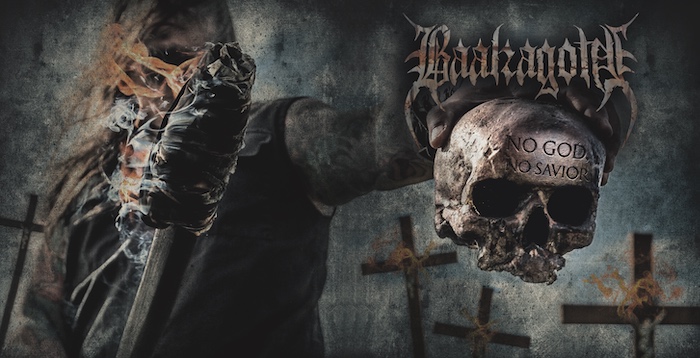
And yes, it's primarily a summary of the album's central idea: a kind of reminder that God is a human invention, a concept created with thoroughly sinister intentions. I think the cover reflects this quite well. The memory of humanity ends with its remains, religious symbols are burning, and everything is shrouded in an unsettling layer of darkness casting a shadow over the sky.
I'd like to spend a moment on the rhythm section. I've been following Miki's development for years, and I get the impression that on the new album he's finally been given the full opportunity to demonstrate what he can do. At a time when there are plenty of drummers capable of playing fast and densely, it's becoming increasingly difficult to find those who have their own feel and character beyond technical ability. What was his role during the making of "No God, No Savior"?
Oktavius: Yes, that's true. Młody has been playing and writing according to his own ideas from the very beginning, hahaha. And I have to say, that suits us just fine. If Miki doesn't feel something, he won't play it. You could stand on your dick trying to convince him, and it still wouldn't work.
I've heard many times that he's not a typical metal machine gun, that there's sometimes a more rock-oriented, or even jazz-like, feel to his playing. That's absolutely true, and that's what gives our rhythm section its distinctive Baalzagoth character.
I think it comes from having such different teachers along the way. Sebastian Matuszak infected six-year-old Młody with the drumming bug. Ireneusz Budny, a respected jazz drummer, probably had the greatest influence on him. Thanks to him, Miki can also play from written notation. Later, he studied with Krzysiek Klingbein for a while.
Mikołaj wrote all the drum parts for the album himself. He always has complete freedom in that department. We trust him, and he listens to our suggestions. He's incredibly creative and can explain to us in musical terms when we're heading in the wrong direction and when we're doing things right. He's got a great ear and instinct.
Well, fuck, he's my son, so there's nothing surprising about that, hahaha.
The recording sessions themselves, however, weren't exactly a walk in the park. The problem was Mikołaj's schooling. The band is one thing, but I've always insisted on one principle: school comes first, playing comes second. On top of that, he lives in a boarding school and doesn't have regular access to his drum kit during the week. This meant Młody couldn't prepare for the recordings as well as he should have. And let me stress that it wasn't his fault. Still, the final result turned out reasonably well.
Once again, you recorded at Heinrich House Studio under Filip's supervision. Did you ever consider trying something new? Or did you know from the beginning that he was the person who would best understand how this album should sound?
Asmodeus: Filip is one of the best professionals in the business. When we approached him to produce our debut, we chose him because previous experiences had taught us two things. First, to produce death metal properly, you have to understand the genre. Second, and no less important, you need to know how to operate the equipment and software. It's a much, much more complex matter than those few words might suggest.
There's another thing worth mentioning: Filip also has experience as a musician and composer. He can really get inside the material and present his own vision. He contributes to the overall result in a significant way: offering advice, telling us what not to do, pointing us in the right direction, and making suggestions.
Of course, the whole process matters: the recording itself, the raw material, achieving the right sound, processing, the entire production process, refining arrangements, adding elements, and even removing things. Production is essentially what gives an album its final character. That's the stage at which it becomes clear what kind of record it will ultimately be.
We were convinced that Filip was the person who could get the absolute maximum out of this material. I should mention, however, that this time we recorded the guitars at Tetra Wave in Kostrzyn (not the one on the Oder River ;).
As for the final shape and result, that was, of course, Filip's work. Personally, I'd be happy to try working with another producer, simply for the experience. But I'm not sure whether that would make sense for Baalzagoth. I've written some music that isn't intended for Baalzagoth, and I hope to record it someday, mainly for myself. That might be the right opportunity.
Oktavius: Sorry, but I'm not going to beat around the bush here. We've said many times that Filip is practically the band's sixth member (and certainly the only one we pay, hehe). He's had and continues to have an enormous influence on what Baalzagoth is today.
Personally, I can't imagine recording our third album anywhere else. At worst, we'll sell our kidneys or rent Camasothz out by the hour.
Anyone who's had the opportunity to work with him at least once will know exactly what I'm talking about. When recording vocals, he can practically give me a stroke, but I love the guy.
The studio remained the same, but the label changed. What was behind that decision, and what do you expect from this new chapter in the band's history?
Asmodeus: I'm not sure we can really call it a change of label. Our agreement with Mara Productions covered one album. We're releasing the second one through Putrid Cult.
This is a different situation from the production side of things. To be honest, there isn't any particular explanation behind the decision, apart from the fact that we simply wanted to try something different and perhaps reach some new listeners. Whether it will actually make a difference remains to be seen.
In any case, we spoke with several labels, and Morgul from Putrid Cult showed enthusiasm for working with us. We already knew and respected his label, so we're grateful for his positive response and looking toward the future with our heads held high.
I'd also like to encourage everyone to support underground labels, including Putrid Cult, Mara Productions, and others. Buy their merchandise and music. That's how you help independent art grow!
The album is now making its way into the hands of listeners. What's next? What are Baalzagoth's immediate plans beyond the obvious live promotion?
Asmodeus: Baalzagoth's plans are centered around promoting the album, with concerts naturally being the most important part of that process.
Unfortunately, technical problems caused considerable delays in the production, so we couldn't really plan our promotional activities very far in advance. Considering that clubs are currently booked solid six to eight months ahead, we don't have too many shows scheduled at the moment. I think we'll push harder at the beginning of next year.
Apart from that, we'd obviously like to make a video. The fact that we're now more geographically scattered across the country doesn't make things any easier. Professional commitments don't help either, which is why the first two singles were accompanied by fairly simple lyric videos on YouTube.
We had intended to do a little more on social media, but that's not as easy as it sounds, mainly because none of us is a TikToker. We more or less understand Facebook and YouTube. Instagram is a different story, and everything else is practically outer space to us.
Nevertheless, promoting our music matters to us, so we'll at least try to remain active on Facebook and YouTube. As for the rest, we'll see. You know, we can't really count on MTV anymore, and TVP or Polish Radio probably won't be interested in playing us either. A shame, really, because I first heard Obituary's "Slowly We Rot" when it premiered on Trójka.
Oktavius: We're also receiving great promotional support from Solid Rock PR, just as we did with the first album. They help get our music to places we wouldn't be able to reach on our own. A huge thank-you to the guys for that!
I know you're more or less devoted to the classic death metal canon and have never been particularly interested in following trends. Has anything you've heard recently genuinely surprised you or completely blown you away? It doesn't necessarily have to be traditional death metal. Maybe some experiments, weird stuff, or music from outside the genre?
Asmodeus: I'm far from being a connoisseur. New music reaches me gradually, usually through recommendations, although I also enjoy exploring YouTube and Bandcamp.
I like discovering new things, and I often look at bands not so much through the lens of their past history but rather from the perspective of their most recent work. Naturally, I follow the Polish scene. I consider it one of the most interesting scenes around, and I'm particularly interested in very young bands. I think that's because I once played in a band like that myself as a teenager (Moloch).
Their music has something different about it. That youthful energy and unpolished approach make me smile when I listen to it, even if the production, for obvious reasons, sometimes leaves a lot to be desired.
I wouldn't want to start naming bands because there are so many interesting releases, and it's easy to leave out someone who deserves a mention. Given my age and certain burdens, I don't really experience those feelings of being surprised or completely blown away anymore. I take in what I see and hear with a certain degree of moderation and curiosity.
Oktavius: Well, because of my age and certain burdens, I still get just as excited about music as I did when I was a kid!
As far as metal goes, I recently had a serious spike in blood pressure while listening to the new Deathepoch album. I absolutely love those Kaos-style combos straight to the face. And Abyssal, too.
For something a little lighter, I'd recommend the latest album by a Polish band called Extensa. They played at Mystic this year. That's the kind of atmosphere I want more of!
Outside metal, the album Hearsay by Piotr Schmidt, an outstanding Polish jazz trumpeter, completely knocked me off my feet.
And finally, to really throw a stick into the anthill... I finally managed to get my hands on a CD of the beautifully recorded opera Andrea Chénier featuring Maria Callas, whom I love beyond words.
Thanks for the conversation. All that's left is to wish you that "No God, No Savior" leaves some suitably deep scars behind. The cross is yours to bear...
Asmodeus: Many thanks for your time, Levi. It was an honor. All the best!
Oktavius: Thanks, buddy! And I'm waiting for the new Neolith album, hehe.
 98
Discography


Upcoming Releases
- The Aeons Torn - Void Artefakkts - Nov 27
- Devastator - Goathammer - Nov 27
- Necroshade - The Last Dawn - Nov 27
- Repentance - Retaliate - Nov 27
- Kalt Vindur - The Void Of Time - Nov 27
- Ulthima - Midnight's Call - Nov 27
- Mystic Prophecy - In Metal - Nov 27
- Whiplash - Roar - Nov 27
- Savage - Malignant Reveries - Nov 27
- Void Chant - Threnody Of Stars - Nov 30
- State:Chaos - The Reckoning - Dec 04
- Witchgöat - Serpent Hordes - Dec 04
- Panzerfaust - The Lucifer Principle - 10th Anniversary Redux Edition - Dec 04
- Haxprocess - Endlessly Flowing Cascades Of Grief - Dec 04
- Amenhotep - Utterances For The Dead - Dec 04
- Nekyian - Impure Stargazing - Dec 09
- Critical Fear - Dark Fate - Dec 11
- Seid - Dystopolis - Dec 11
- Agrimonia - Of The Shadows - Dec 11
- Gorgatron - Turmoil - Dec 11