
Azeroth - Interview
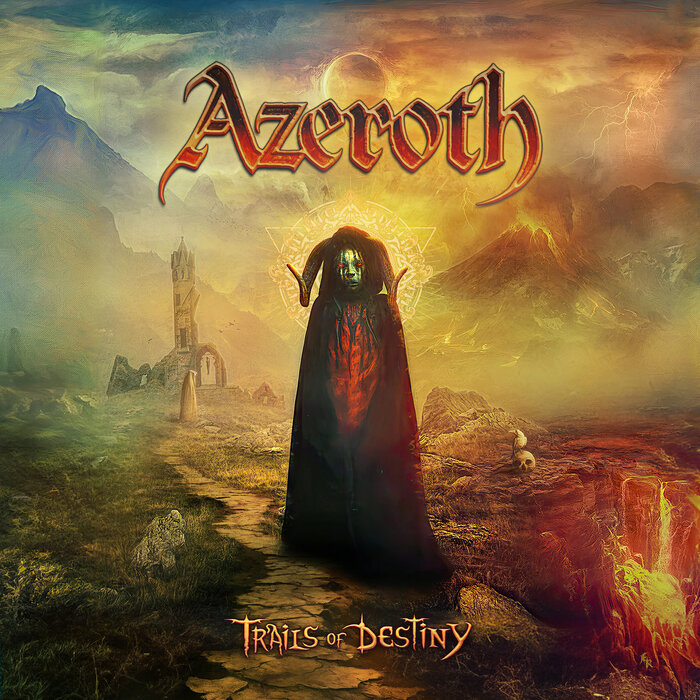
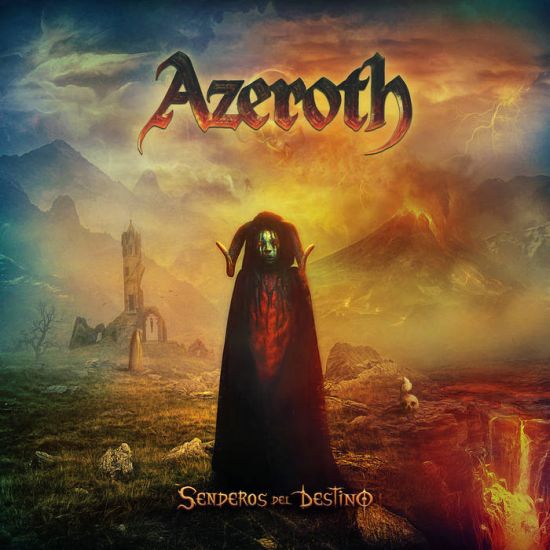
For some time now, Azeroth has been more than just one of Argentina's leading power metal bands—they've also built a strong connection with Brazilian audiences. After opening for Angra in Brazil, paying tribute to Viper, and strengthening ties with the country's metal scene, the band now presents Trails of Destiny, the English-language counterpart to Senderos del Destino (2022), furthering its international ambitions. In this interview, vocalist Ignacio Rodriguez discusses rewriting the album's lyrics for a new language, working with Fabio Lione, the challenges faced by South American metal bands, the influence of Brazilian metal, and the excitement of sharing the stage with Helloween at Buenos Aires' Movistar Arena.
Marcelo Vieira (@marcelovieiramusic)

"Trails of Destiny" is the band's first album entirely in English, but it stems from a reimagining of "Senderos del Destino". What motivated this language switch?
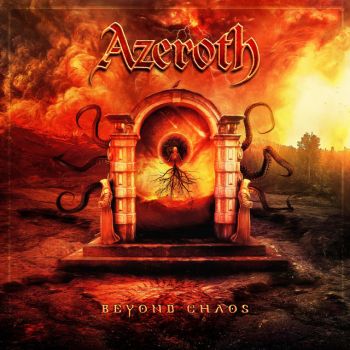
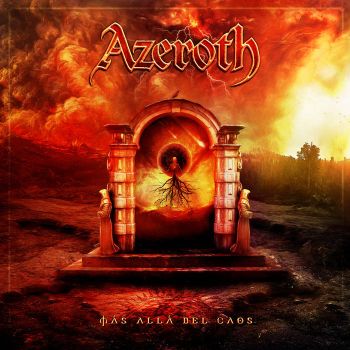
Actually, it wasn't the first. We had already done that with Beyond Chaos, the English version of Más Allá del Caos. While working on that album, the idea came up to do the same with other records. Shortly after, we received an invitation from Angra to play in Buenos Aires, followed by an opportunity to tour Brazil. We realized that if we wanted to reach more people and play in other countries, it made sense to release English versions of our songs.
Did the lyrics need to be completely rewritten to work in the new language?
Yes. There is no such thing as a literal translation. We kept the same message, but all the lyrics were rewritten from scratch. You have to respect the rhythm, melody, accentuation, and the way words sound when sung. Translating word-for-word simply wouldn't work.
Did you feel that any emotion or nuance from the original versions was lost during the process?
I wouldn't say it was lost, but it certainly changed a bit. Singing in English is different from singing in Spanish, which is my native language. Even so, I've been singing in English for about fifteen years, so I'm quite used to it. In fact, for some songs, I actually prefer the sound of the melodies in English. Each language has a different sound, and that influences the interpretation.
Does that preference also have to do with the fact that power metal is a genre traditionally associated with English?
Definitely. The biggest bands and key influences in power metal sing in English. When you start listening to the genre, it's almost always through bands that use that language. In Argentina, we have important groups—like Rata Blanca—that lean toward power metal but don't exactly embody the style. So, we grew up listening to our idols singing in English, and it ends up becoming something very natural.
Since "Senderos del Destino" is still a relatively recent album, was there any temptation to use this new version to correct or change anything you would do differently today?
Senderos del Destino brought us many achievements. It was with this album that we had the opportunity to play in Brazil for the first time, and now we're taking this work to Chile as well. So, it didn't make sense to change much about it. Of course, there's always something you'd do differently, but we prefer to save that evolution for the next album. The band has grown a lot since those first international tours, and all that experience is naturally being incorporated into the new songs we're writing.
I often say that Brazilian audiences only start to value a domestic band after it gains recognition in Europe or the United States—as if foreign approval acts as a seal of quality. Does the same thing happen in Argentina?
Yes, exactly the same thing happens. There's this common idea of saying, "This band sounds like a foreign band." But why should that be a compliment? We're an Argentine band and we want to sound like an Argentine band, while still doing professional work. I think this is a common problem across South America. If local bands had the same financial resources as European ones, they could reach the exact same level. That prejudice needs to end.
In your opinion, what is needed to change this mindset?
We need to strengthen the scene as a whole. In Europe, there's much greater unity among bands, record labels, and the market. Just look at Finland: Nightwish, Children of Bodom, Sentenced, Amorphis, Sonata Arctica, and Stratovarius all grew up around the same time because there was a structure supporting multiple bands simultaneously. When there's room for many artists, the entire scene gets stronger. We also need audiences to give a chance to the local bands that open for international acts. There are a lot of people doing excellent work.
Interestingly, you mentioned only bands that sing in English. Ultimately, does this issue come down more to language than geography?
That could be it. In Argentina, there's a strong barrier regarding English due to historical reasons—mainly the Falklands War. When we started, a lot of people asked why we sang in English instead of Spanish. There's a strong cultural component to it. I don't know if it's the same in Brazil, but here, that debate has always been present.
Power metal is often associated with virtuosity. How do you prevent technical skill from overshadowing the emotion of the songs?
That's a great question. Many people think power metal is just about playing really fast or showing off technique, but we believe the music needs to go beyond that. Acero was born out of passion ...by heavy and speed metal. We are heavily influenced by the early era of Sepultura and by bands like Blind Guardian, who manage to combine aggression with memorable melodies. In our music, melody always comes first. All arrangements are built around it, which prevents technical skill from becoming an end in itself.
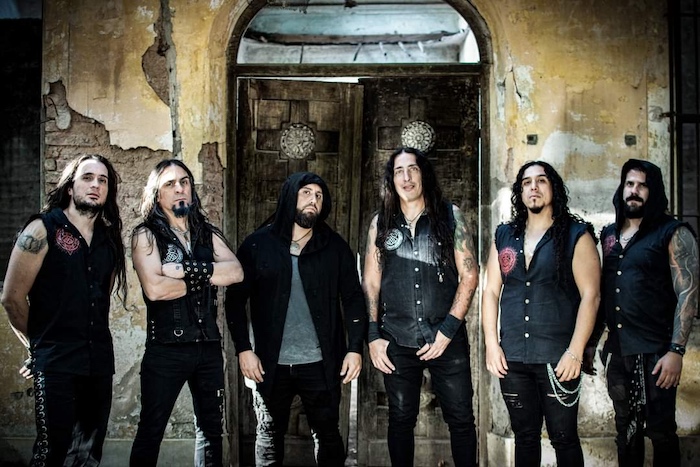
Speaking again about that "foreign validation," the album features Fabio Lione. What did his presence add to the work artistically?
First of all, it was a great opportunity. We met Fabio when he was in Argentina with Rhapsody and Angra. We had a brief chat; he listened to the band, liked what he heard, and said we could talk more later. Since we were already planning to record an album in English and invite an internationally recognized musician, his name came up naturally. Beyond the artistic contribution, observing his work process was a very enriching experience. It also showed us that the band is capable of operating at an international level.
Did you feel extra pressure having a world-renowned musician working directly with you?
Not really. Everything happened very naturally. The band is currently going through a phase where many important things are happening, including collaborations with big names in power metal. Fabio is a world-renowned artist who does incredible work, but at the end of the day, he's a musician just like us. We worked together as equals. Plus, he's an extremely humble and pleasant person, which made the whole experience very smooth.
Another striking aspect of the album is the Viper cover "Prelude to Oblivion", which brings the band even closer to Brazil. What does Viper—and Brazilian metal more broadly—represent in your development as a musician?
Acero was founded by our bassist, Fernando Ricciardulli, and it all started because he heard Soldiers of Sunrise here in Argentina. I think it was in the early 90s, when the album first arrived here. That left a deep mark on his life. In 2018, we decided to pay tribute to Viper, and after André Matos passed away, that idea took on even greater significance. We released an EP before our first tour of Brazil and included that cover specifically to celebrate that legacy.
What makes Brazilian audiences different in terms of energy and receptiveness?
What impressed us most was the reception we got at the band's very first show outside Argentina—in Curitiba. We didn't know what to expect, but as soon as we started playing, the crowd sang along, got involved, and responded in an incredible way. Back in Argentina, that usually only happens when a foreign band is playing. In Brazil, it was different. We finished the first song, and the reaction was so intense that it took us a while to even start the second one. It was an indescribable feeling—a mix of achievement, gratitude, and fulfillment. It's been a few years now, but I remember that moment as if it happened yesterday.
Sharing the stage with Helloween at the Movistar Arena—one of the bands that helped define power metal—carries enormous symbolic weight. What was it like to receive that invitation?
Without a doubt. We had already worked with the same promoter on shows for bands like Stratovarius and Powerwolf, so they mentioned the possibility of us playing with Helloween the following year. At the time, it was just a possibility. When I got the confirmation, I was at my parents' house. Shortly after, I saw the official poster on Instagram with our band's name on it. It was an incredible thrill. A whole movie of memories flashes through your mind because you remember all the struggles you've faced since the beginning. Sharing the stage with one of the bands that created the genre we play, in a venue like the Movistar Arena, is priceless. There is, of course, a greater sense of responsibility, but above all, it's a moment of celebration.
Are experiences like that what help keep the band's creativity and motivation alive, even after lineup changes and so many challenges?
Absolutely. Ever since we started playing outside Argentina—especially in Brazil—everything has entered a very positive phase. We're also heading to Chile now and are in talks with producers and musicians from various places. All these experiences help the band grow and directly influence our new music and even our visual identity. We have a lot of new things planned for 2026, and I believe the highlight of this period will be the show with Helloween at the Movistar Arena. We are living through a very special time.
 805
805
Discography
Upcoming Releases
- Terrestrial Hospice - Omnicide - Chapter I - Sep 11
- Godslave - Godslave - Sep 11
- Epitaphe - III - Sep 11
- Cartilage - Operating Altar - Sep 11
- Harlott - Exsequiis - Sep 11
- From The Vastland - Servant Of Ahriman - Sep 11
- Neolith - Inbir - Sep 12
- Blodtår - Monark - Sep 18
- Game Over - When Darkness Falls - Sep 18
- Revel In Flesh - Flesh For The Kult Of Death - Sep 18
- Runemagick - After Chaos: Nocturnal Vigil - Sep 18
- Garota - Strąceni W Ciemność - Sep 18
- Massteron - Second In The Spheres - Sep 24
- Tombstalker - Chaos Monolith - Sep 24
- Noctule - Extinguish Thy Flame - Sep 25
- Draugr - Ahnenfeuer - Ginnungagap Chaos Pt. I - Sep 25
- Wharflurch - Mycodeath And Rebirth In The Outer Clusters - Sep 25
- Critical Defiance - Rivers Of Blood - Sep 25
- Stellar Silence - Expeditio - Sep 25
- Eternal - Conspiracy Of Warheads - Sep 28