Live Burial - News
A Career Built on Rot: The Legacy of Live Burial

When it comes to many modern death metal bands, there is an incredibly thin line between inspiration and shameless copying, between paying tribute to the classics and becoming nothing more than a historical reenactment group faithfully recreating a 1991 Death tour. Most of these hordes either crash into that line at full speed or sink so deeply into nostalgia that they end up resembling a museum of old-school death metal rather than a living, breathing band. England's Live Burial have spent their career walking that edge with surprising confidence — like a drunk gravedigger balancing on a cemetery wall — and they never fell off. In fact, they always came out victorious, shovel over their shoulder and a killer riff lodged between your ribs. The Newcastle lads played from the very beginning as if, instead of rehearsing in a practice room, they regularly held séances with the spirits of Bolt Thrower, Autopsy, and the old days of Death. They took all that rotten, muddy, and decaying old-school death metal filth, threw in some doom-infested stench and a bit of thrash gallop, and the result was music as heavy as a gravestone, sounding as if it had been recorded in a basement beneath a morgue. At the same time, they never sounded like another gang of cosplayers wearing Leprosy shirts and confusing inspiration with copying their homework. Live Burial had character from the start — the kind that smells of dampness, an old beer-soaked amplifier, and a crypt that you probably shouldn't enter alone.
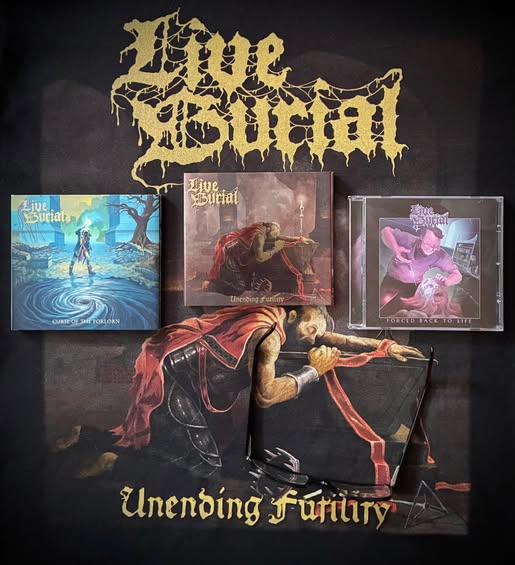
Their debut album, "Forced Back To Life" from 2016, was 35 minutes of pure death metal devastation. No nonsense, no modern polishing designed for Spotify playlists made for people doing deadlifts. This album kicked the door in. The riffs hit like bricks thrown into a cement mixer, the drums attacked without mercy, and the vocals sounded like someone had awakened a corpse after thirty years of rotting in the mud. Of course, the influence of the British death metal scene was obvious — Benediction, Bolt Thrower, even early Paradise Lost appeared in those slower moments — but there was just as much American filth in the vein of Autopsy and Abscess. Yet it never felt like a museum reconstruction. This was not a case of "look, we can play like it's 1991." "Forced Back To Life" had that youthful arrogance and the kind of energy that made you instinctively want to flip the table in your room.
Four years later came "Unending Futility", and things became even more interesting. If the debut was a brutal shovel blow to the back of the head, the second album proved these guys could really write songs. It was still heavy as hell and still dripping with graveyard atmosphere, but now there was more technique, progressive twists, and incredible bass work. Seriously, the bass on this record deserves its own monument made from bones and empty beer cans. Lee Anderson wasn't politely plucking away in the background — he was running through the songs like a possessed jazz musician who had been ordered to play death metal. The influence of Death's "Human" era was so obvious that at times you almost wanted to check whether Chuck Schuldiner had somehow risen from the dead. But again, Live Burial were not mindlessly hammering away like a tribute act. They took that technical momentum and blended it with doom crawling, Swedish filth, and riffs with more groove than half of today's so-called groove metal bands combined. Tracks like 'Rotting On The Rope', 'The Crypt Of Slumbering Madness', and 'Cemetery Fog' showed a band that understood how to build tension, slow down, speed up, and suddenly hit you with a riff so devastating that your face twisted into the classic death metal expression of approval.
Finally, there was "Curse Of The Forlorn" in 2022 — the moment when Live Burial sounded like a band completely confident in its own strength. The third album was more ambitious, more refined, and at times absurdly dense. There was so much happening that the first listen could leave you completely overwhelmed — like being thrown into a washing machine filled with riffs, blast beats, and solos. But once the chaos began to reveal its structure, a massive beast emerged. The band still had one foot planted firmly in classic death metal, but increasingly developed its own atmosphere — darker, more ominous, and occasionally stepping into blackened death metal territory. There were melodies, monumental slow sections, and long compositions that could have collapsed under the weight of their own ambition, but instead they dragged the listener deeper and deeper into the crypt. The production was fantastic: everything breathed, everything had space, and yet it still sounded like a gigantic wall of rotten flesh. The great thing about Live Burial was that, despite all the technique and old-school scholarship, they still sounded like a bunch of people who simply loved death metal. They did not calculate, they did not pretend to be avant-garde for reviewers with beards and notebooks, and they were not trying to create a soundtrack for craft IPA tastings. This was music for people who wanted to smell the grave, take a riff straight to the teeth, and believe for a moment that 1992 never actually ended.
And why have I been writing in the past tense this entire time? Well, the gentleman perhaps got a little too immersed in the subject of death, because some time ago, Live Burial called it a day. A shame, really, because they were surprisingly good at digging through corpses.
Norbert
Entered: 6/20/2026 3:01:48 AM
927