
Tar Pond - News
Tar Pond: Drowning in a Swamp of Doom

Swiss outfit Tar Pond may not have an extensive discography, with just two albums released under this name so far, but the band behind it has a rather interesting history. They started in 2015 as a project involving Marky Edelmann of Coroner, Martin Eric Ain of Celtic Frost, and Thomas Ott, a highly regarded Swiss artist known for his distinctive black-and-white comics. In Tar Pond, Ott traded his ink drawings for a microphone, although judging by the band's music, his fondness for all things dark has certainly remained intact.
Their debut album, "Protocol Of Constant Sadness," was recorded with Martin Ain still on bass, but his death in 2017 disrupted the band's plans, and the record did not see the light of day until three years later. It consists of just four lengthy compositions and presents doom metal in an extremely gloomy, at times almost ascetic form. An unusual take on the genre, particularly for its die-hard devotees. Massive riffs sit alongside acoustic guitars, synthesizers, strange solo passages, and subtle melodic details that effectively challenge the conventions of the style. The opening track, "Damn," makes it clear that Tar Pond have no intention of simply turning their amplifiers up to eleven and seeing who breaks first. Instead, they prefer to build tension patiently, delivering their heaviness in measured doses and allowing it room to resonate. "Protocol Of Constant Sadness" does not attempt to reinvent doom metal, but it has a character of its own and an unsettling atmosphere that becomes increasingly effective with each listen.
By the time "Petrol" arrived in 2023, Tar Pond had become a different band, both in terms of personnel and sound, and their music had grown considerably more powerful. Five tracks spread across just under forty minutes rely on minimalist, low-tuned riffs, a massive bass presence, and rhythms that are in no hurry to get anywhere. Tar Pond are economical with their riffs: once they find a good one, they see no reason to start looking for another thirty seconds later. The ten-minute opening track, "Bomb," is the perfect example. Its central motif does not so much flow as move with the dignity of a continent: slowly, inevitably, and without the slightest concern for whether anyone else is in a hurry.
Doom remains the foundation of "Petrol," but Tar Pond build something considerably harder to pigeonhole on top of it. There is sludge-infused grime, a stoner-like pulse, post-metal expansiveness, occasional wisps of shoegaze haze, and a gloomy, bass-driven majesty accompanied by distinctive descending chord progressions that may bring Type O Negative to mind. This is not about copying specific tricks, but rather about a similar approach to using heaviness and melancholy. Somewhere beneath it all, the spirit of Celtic Frost can also be heard, perhaps not so much in the riffs themselves as in the way the band approaches heaviness. Particularly the later Celtic Frost of "Monotheist": monumental, restrained, and fully aware that sometimes a single note held for long enough carries more weight than a dozen of them. Tar Pond take this idea and filter it through doom-laden melancholy, slowing it down even further. "Blind" picks up the pace and becomes more direct, "Slave" drags everything back down, "Something" makes more room for atmosphere, reverb, and vocal harmonies, while the closing track, "Dirt," returns to crushing heaviness after a quieter, almost ethereal beginning. Comparisons to Alice In Chains are unavoidable. They can be heard in the melancholy, certain guitar passages, harmonized vocals, and something of the dirty, suffocating atmosphere of "Dirt." However, reducing Tar Pond to Alice In Chains playing doom would be a considerable disservice to this album. It is just one of many reference points along the way, alongside Black Sabbath, Celtic Frost, Saint Vitus, sludge, post-metal, and the aforementioned Type O Negative, but none of them fully explains what this record is about.
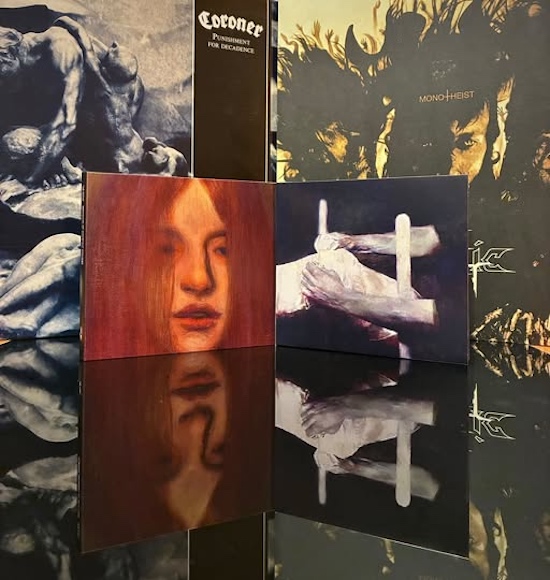
Thomas Ott is an interesting character in his own right. His distinctive vocals may remind some listeners of Layne Staley, but at times I find myself thinking of another, geographically much closer comparison: Franz Treichler of The Young Gods. It is not even a matter of identical vocal timbres, but rather the coldness, a certain detachment, and the way the voice floats above the heavy, repetitive instrumental backdrop. Considering that Tar Pond brings together musicians associated with Celtic Frost and Coroner, the presence of yet another Swiss spirit hovering over this music seems entirely appropriate.
Despite their simplicity, Tar Pond's albums are far from one-dimensional. The basic riffs can be almost primitively economical, but around them emerge subtle guitar details, dissonances, reverberations, shifts in dynamics, and brief moments of respite. These elements prevent the compositions from blurring into a single forty-minute steamroller. Listening to Tar Pond is more like trudging waist-deep through tar: each successive step requires more effort, and after a while, you realize that you don't really want to get out anymore.
Somewhere between Type O Negative, Alice In Chains, classic doom, sludge, and the more experimental traditions of Swiss heavy music, Tar Pond have carved out a swamp of their own. And they clearly have no intention of leaving it. Next week, they will be bringing that swamp to Poland for two shows, opening the evenings for their compatriots in Coroner. So, if you want to find out just how much "Petrol" weighs outside the studio, you may not get a better opportunity anytime soon.
Norbert
Entered: 10/9/2026 2:03:12 AM
129
Latest Reviews
 Critical Defiance
(9.5)
Critical Defiance
(9.5)
|
 Days Ov Yore
(9)
Days Ov Yore
(9)
|
 Throneum
(8.5)
Throneum
(8.5)
|
 Ch'ahom
(9)
Ch'ahom
(9)
|
 Boötes Void
(8.6)
Boötes Void
(8.6)
|
 Xion
(8)
Xion
(8)
|
 Terrestrial Hospice
(8.5)
Terrestrial Hospice
(8.5)
|
 Astral Alchemy
(7.5)
Astral Alchemy
(7.5)
|
 Mastodon
(9)
Mastodon
(9)
|
 Vigil
(10)
Vigil
(10)
|
 Krolok
(8.3)
Krolok
(8.3)
|
 Garota
(8.5)
Garota
(8.5)
|
 Αχεροντας
(9)
Αχεροντας
(9)
|
 Neolith
(9)
Neolith
(9)
|
 Asgrauw
(8.5)
Asgrauw
(8.5)
|